
Automated door systems represent a critical integration of sensor technology, mechanical engineering, and access control logic. These systems facilitate contactless entry, improve energy efficiency by maintaining climate control, and ensure compliance with accessibility standards. Modern infrastructure relies on sophisticated drive units and high-frequency sensors to manage pedestrian and vehicular traffic flow safely and efficiently.
Technical Classification of Automated Entrance Solutions
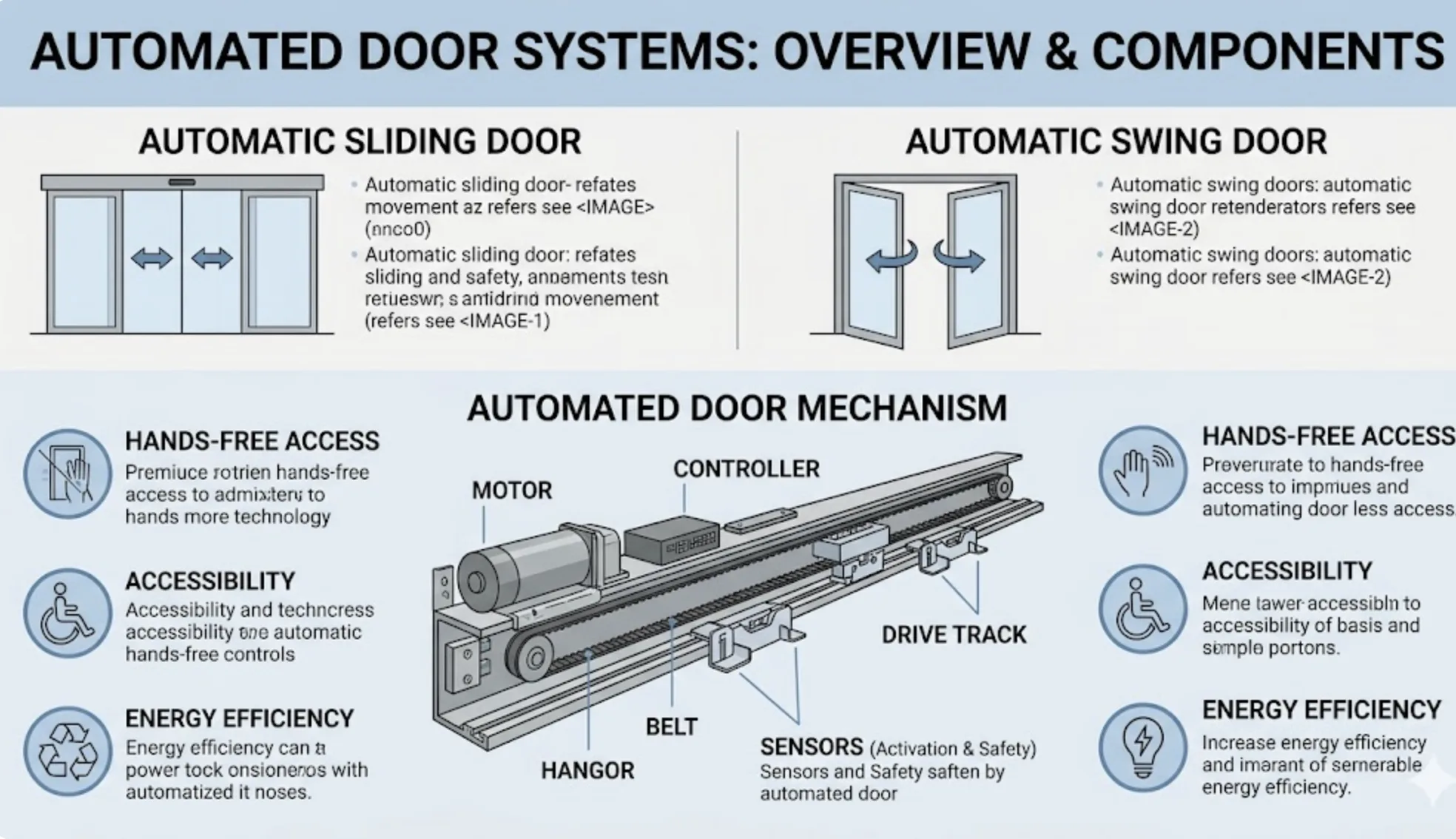
Automated door systems are categorized based on their mechanical movement and the drive technology employed. The primary types include sliding doors, swinging doors, and revolving doors, each serving specific traffic densities and architectural requirements. Commercial buildings often implement automatic sliding doors to maximize space efficiency while providing a wide clear opening for high-traffic environments.
The selection of a drive system depends on the weight of the door leaves and the frequency of operation. Electro-mechanical drives use gear motors to transmit torque, whereas electro-hydraulic systems utilize fluid pressure for heavy-duty applications. According to the Grand View Research report on automated doors, the global market expansion is driven by the integration of Internet of Things (IoT) sensors that allow for remote monitoring and predictive maintenance.
| Door Type | Typical Application | Key Benefit | Traffic Capacity |
| Sliding | Retail & Healthcare | Space-saving | High |
| Swinging | Offices & Corridors | Easy Retrofitting | Low to Medium |
| Revolving | Luxury Hotels/Banks | Energy Conservation | Continuous |
Advanced Sensor Technology in Automatic Door Openers
The operational safety of automated entrances relies on advanced detection sensors that utilize Microwave, Active Infrared (AIR), or Passive Infrared (PIR) technologies. Microwave sensors excel at detecting motion from a distance, making them ideal for activation. In contrast, Active Infrared sensors are essential for presence detection, ensuring the door does not close while a person or object remains in the threshold.
Technical standards such as ANSI/BHMA A156.10 define the safety requirements for power-operated pedestrian doors. These regulations mandate specific detection zones and closing speeds to prevent impact injuries. Research published by the National Institute of Building Sciences highlights that sensor-based entry systems reduce touch-points by 99%, significantly lowering the transmission of pathogens in public facilities.
Energy Efficiency and Thermal Performance of Commercial Door Systems
Automated doors serve as thermal barriers that minimize the exchange of indoor and outdoor air. By ensuring that doors remain open only for the duration of a passage, these systems reduce the workload on HVAC systems. High-performance automatic revolving doors are particularly effective at preventing “chimney effects” or drafts in high-rise buildings, maintaining a stable internal temperature.
Data indicates that building envelopes account for nearly 30% of total energy consumption in commercial structures. According to the U.S. Department of Energy (DOE), optimizing entrance automation can contribute to LEED certification by improving the Energy and Atmosphere (EA) category scores. Modern systems now incorporate “low-energy” modes that adjust opening speeds based on ambient temperature and traffic frequency.
Integration of Access Control and Security Features
Modern automated entrance systems are frequently integrated with building management systems (BMS) and electronic access control. This integration allows facility managers to restrict entry based on time schedules, biometric data, or RFID credentials. During emergency scenarios, fail-safe automatic door controllers ensure that doors unlock or open automatically to facilitate rapid egress, adhering to strict fire safety codes.
The synchronization between the door motor and the locking mechanism is managed by a central microprocessor. This controller monitors the electrical load and can detect obstructions through back-EMF (Electromotive Force) sensing. Technical whitepapers from the Security Industry Association (SIA) suggest that encrypted communication protocols between the reader and the door controller are vital to preventing unauthorized digital overrides.
Maintenance Protocols for Industrial Automatic Doors
Routine inspection and maintenance are mandatory to ensure the longevity and safety of automated door components. Wear-and-tear parts such as rollers, timing belts, and floor guides require periodic lubrication and tension adjustment. Professional technicians utilize specialized diagnostic tools to calibrate sensor sensitivity and verify that the automatic door safety sensors function within the parameters defined by the manufacturer and local safety codes.
Failure to maintain these systems leads to increased operational friction, higher energy loss, and potential liability risks. The Occupational Safety and Health Administration (OSHA) provides guidelines on the safety of mechanized equipment in the workplace, emphasizing that daily safety checks should be performed by onsite staff. A structured maintenance schedule typically includes testing the emergency stop buttons and verifying the battery backup functionality.
Comparison of Actuation Methods
| Actuation Type | Mechanism | Best Use Case |
| Motion Sensor | Radar/Infrared | General Public Access |
| Push Plate | Physical/Touchless Switch | ADA Compliance |
| Access Control | Card/Biometric | Restricted Areas |
ADA Compliance and Universal Design in Entrance Solutions
The Americans with Disabilities Act (ADA) sets forth stringent requirements for door widths, opening forces, and closing speeds. Automated doors are the gold standard for achieving universal design, as they eliminate the physical effort required to operate heavy manual doors. Implementing ADA compliant door operators ensures that individuals with mobility aids can navigate buildings independently and safely.
Specific requirements include a minimum clear opening width of 32 inches and a maximum closing speed that allows safe passage. The United States Access Board provides technical specifications for automated door maneuvering clearances. Compliance is not merely a legal obligation but a strategic investment in inclusivity that expands the accessible footprint of a commercial property.
FAQ
What is the primary difference between a motion sensor and a presence sensor in automated doors?
Motion sensors, typically using microwave technology, detect approaching objects to trigger the opening cycle. Presence sensors use active infrared beams to monitor the threshold area constantly. Their primary function is to prevent the door from closing if an object or person is detected within the path of the door leaves.
How do automated door systems maintain operation during a power failure?
Most professional-grade systems include an integrated Battery Back-Up (BBU) unit. This system provides enough power for a specific number of cycles or defaults the door to a “Fail-Safe” open position. In fire emergency modes, the system interfaces with the building’s fire alarm to ensure unobstructed egress routes.
What factors influence the lifespan of an automatic sliding door motor?
The lifespan is determined by the daily cycle count, the weight of the door glass, and the consistency of professional maintenance. High-traffic environments require heavy-duty brushless DC motors, which offer better heat dissipation and durability. Regular cleaning of the track and rollers prevents premature motor strain and gear wear.
Can existing manual swinging doors be converted to automated systems?
Yes, manual doors can be retrofitted with surface-mounted automatic swing operators. This process involves installing a drive unit above the door frame and connecting it to the door leaf via a push or pull arm. However, the existing frame must be structurally sound to support the weight and torque of the operator.
What is a “Low Energy” operator versus a “High Energy” operator?
Low Energy operators move slowly and require a physical trigger, like a push plate, making them safer for environments with elderly or disabled users without needing extensive safety sensors. High Energy operators are fully automatic, move faster, and require comprehensive safety sensor arrays to comply with ANSI/BHMA A156.10 standards.