
Automatic door systems represent a sophisticated fusion of mechanical engineering, electronic control, and sensor technology. According to recent industry analysis by the International Association of Automated Door Manufacturers (IADM), the global market for these systems is projected to maintain a compound annual growth rate (CAGR) of 5.2% through 2026. This growth is driven by increasing demands for accessibility compliance, energy conservation, and touchless entry solutions in commercial environments. Modern systems facilitate seamless pedestrian flow while maintaining internal climate control and security protocols.
Essential Components of Automatic Sliding Door Operations
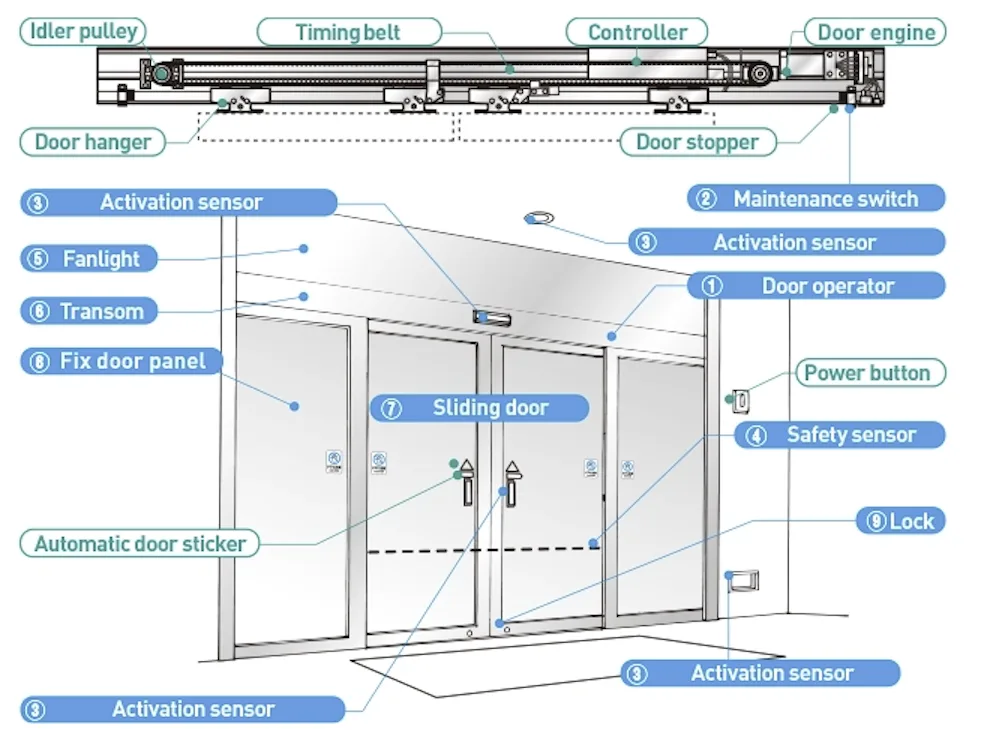
The primary functional unit of an automated entrance is the automatic door operator, which houses the motor and control logic. A standard system consists of the header profile, the drive motor, a microprocessor controller, and the carrier-hanger assembly. Data from the U.S. Department of Energy suggests that properly calibrated operators can reduce building energy loss by up to 24% compared to doors left ajar by manual use. The operator translates electrical energy into precise kinetic motion, managing the acceleration and deceleration phases of the door cycle to ensure user safety.
Drive Units and Motor Technology
The automatic door motor serves as the powerhouse of the entire assembly, typically utilizing Brushless DC (BLDC) technology in 2026 models. BLDC motors offer superior longevity and quieter operation compared to traditional brushed variants because they eliminate friction-heavy components. These motors are coupled with a reduction gearbox to provide high torque at low speeds, ensuring that heavy tempered glass panels move smoothly. Integrated encoders within the motor assembly provide real-time feedback to the controller regarding the exact position and velocity of the door leaves.
Sensor Technology for Activation and Safety
Safety and activation are managed by a network of automatic door sensors that utilize microwave, active infrared (AIR), or passive infrared (PIR) technologies. Microwave sensors generally handle motion detection for door activation, while active infrared sensors create a “safety curtain” to prevent the door from closing on stationary objects. Compliance with the ANSI/BHMA A156.10 Standard is mandatory for power-operated pedestrian doors to minimize the risk of impact. Modern sensors are designed to distinguish between cross-traffic and approaching pedestrians to prevent unnecessary opening cycles.
| Sensor Type | Detection Technology | Primary Function | Ideal Application |
| Microwave | Radar Doppler Shift | Motion Activation | High-traffic retail entrances |
| Active Infrared | Light Reflection | Presence Sensing/Safety | Threshold protection |
| Passive Infrared | Heat Signature | Detection | Energy-sensitive environments |
| Dual-Tech | Combined AIR/Microwave | Activation & Safety | High-security or medical facilities |
Microprocessor Controllers and Logic Management
The controller acts as the central nervous system, processing signals from the sensors and executing commands to the drive unit. Sophisticated logic boards allow technicians to adjust hold-open times, opening speeds, and braking distances. In 2026, many controllers feature IoT integration, allowing facility managers to monitor door cycles and diagnostic codes remotely. The controller also interfaces with fire alarm systems, ensuring that doors default to a specific state (fail-safe or fail-secure) during emergency evacuations as required by NFPA 101 Life Safety Code.
Transmission Systems and Drive Belts
Mechanical power is transferred from the motor to the door panels via a reinforced automatic door belt and pulley system. These belts are typically constructed from high-tensile materials like neoprene or polyurethane, reinforced with fiberglass or steel cords to prevent stretching. The belt connects to the door carriers, which slide along a precision-machined track. High-quality track surfaces are essential for reducing vibration and acoustic noise. Consistent tension in the drive belt is necessary to prevent slippage and ensure the microprocessor’s positional data remains accurate over thousands of cycles.
Comparison of Drive System Specifications
| Specification | Standard Commercial System | Heavy-Duty Industrial System |
| Motor Power | 75W – 100W | 150W – 250W |
| Max Leaf Weight | 100kg – 120kg | 200kg – 600kg |
| Opening Speed | 0.5 – 0.7 m/s | 0.3 – 0.5 m/s |
| Expected Cycle Life | 1,000,000 cycles | 5,000,000+ cycles |
Hangers, Rollers, and Guide Components
The physical weight of the door is supported by the automatic door hanger and roller assembly. Each hanger typically features heavy-duty nylon or urethane wheels with sealed ball bearings to ensure low-friction movement. Floor guides, often overlooked, are critical for preventing the door panels from swinging or oscillating during movement. These guides are usually made of low-friction polymers like Delrin to minimize resistance. Properly aligned hangers and guides extend the lifespan of the motor by reducing the force required to initiate and sustain movement across the track.
Hardware for Manual and Remote Overrides
Standard installations include various automatic door accessories such as function key switches, remote controls, and backup battery units (UPS). Key switches allow the door to be set to different modes: Automatic, Exit Only, Partial Open, or Locked. Battery backups are a critical safety feature, ensuring the door can perform a minimum of one full cycle or remain open during a power failure. Furthermore, integrated electric locks provide security when the system is in “Night Mode,” physically pinning the door panels to the track or frame to prevent forced entry.
System Integration and Modern Applications
Automatic door systems are frequently integrated with building management systems (BMS) and access control hardware. According to the Building Services Research and Information Association (BSRIA), integrated building tech accounts for a significant portion of new commercial construction costs in 2026. This integration allows for sophisticated scenarios, such as restricting entry based on biometric data or adjusting door speeds based on real-time weather conditions. Using standardized communication protocols like BACnet or Modbus allows the door controller to share data with the wider facility network for improved operational efficiency.
FAQ
What is the difference between an automatic sliding door and a swing door operator?
An automatic sliding door operator moves panels laterally along a track, ideal for high-traffic areas where space is limited. In contrast, a swing door operator uses a motorized arm to push or pull a standard hinged door. Sliding systems generally offer better energy efficiency and higher pedestrian throughput capacities.
How often should an automatic door system undergo professional maintenance?
Industry standards recommend professional inspections at least once every six months. High-traffic locations, such as hospitals or major retail centers, may require quarterly checks. Regular maintenance focuses on sensor calibration, belt tensioning, and lubrication of the roller assemblies to prevent mechanical failure and ensure safety compliance.
Can an existing manual door be converted into an automatic system?
Yes, manual doors can often be automated using “retro-fit” operators. For swing doors, an overhead operator is installed on the frame. For sliding doors, the entire header and track assembly must usually be replaced. Conversion requires ensuring the door frame can support the additional weight and electrical requirements.
What safety features are required to prevent the door from hitting pedestrians?
Automatic doors must include presence-sensing safety sensors and “slow-speed” settings. Safety sensors detect stationary objects in the door’s path, preventing it from closing. Additionally, systems include force-sensing logic where the motor reverses direction if it encounters unexpected resistance, significantly reducing the risk of injury during a collision.
Which sensor technology is best for a facility with high energy-saving goals?
Dual-technology sensors are best for energy conservation. They combine microwave motion detection (to open the door only for approaching traffic) with infrared presence sensing (to ensure safety). This prevents “ghost openings” caused by cross-traffic or wind, keeping the door closed more often and maintaining internal climate control.