
Automatic door motors are the core drive components inside modern entrance automation systems. Among all motor configurations, Sliding Door Motors and Swing Door Motors are the two most widely used categories in commercial, healthcare, residential, and public buildings. The main difference is movement direction: a sliding door motor moves the door panel horizontally, while a swing door motor opens the leaf inward or outward on hinges.
Selecting the correct automatic door motor affects safety, access speed, noise level, installation cost, and long-term maintenance. According to the U.S. Department of Energy, building entrances influence conditioned air loss and operating efficiency, making door automation an important part of facility performance. Buyers comparing systems often review automatic door motor, sliding door operator, swing door motor, automatic door opener, commercial door automation, and automatic door spare parts.
Automatic Door Motor Basics for Entrance Automation Systems
An automatic door motor converts electrical energy into controlled motion. The motor works with a controller, sensors, safety devices, and mechanical transmission parts. Motion sensors detect approaching users, the controller sends commands, and the motor performs the opening cycle.
Most modern automatic door motors use DC brushless technology because brushless systems reduce wear and improve speed control. The National Institute of Standards and Technology (NIST) emphasizes precision motion and control consistency in industrial systems, and similar principles apply to automated entrances where repeatable movement is essential.
| Component | Function | Result |
|---|---|---|
|
Motor |
Creates motion |
Opens and closes door |
|
Controller |
Logic control |
Adjusts speed and timing |
|
Sensor |
Detects approach |
Triggers operation |
|
Safety Beam |
Prevents collision |
Safer access |
How Automatic Sliding Door Motors Work
A sliding door motor drives one or two door panels along a track. The system commonly uses a belt, pulley, carriage rollers, and guide rail. When the motor rotates, the belt pulls the panel sideways to open the entrance.
Sliding door motors are common in retail and transport buildings because the opening path does not require front clearance. This layout improves traffic flow in narrow corridors or busy entrances. Many facility managers choose automatic sliding door motor systems for continuous pedestrian movement.
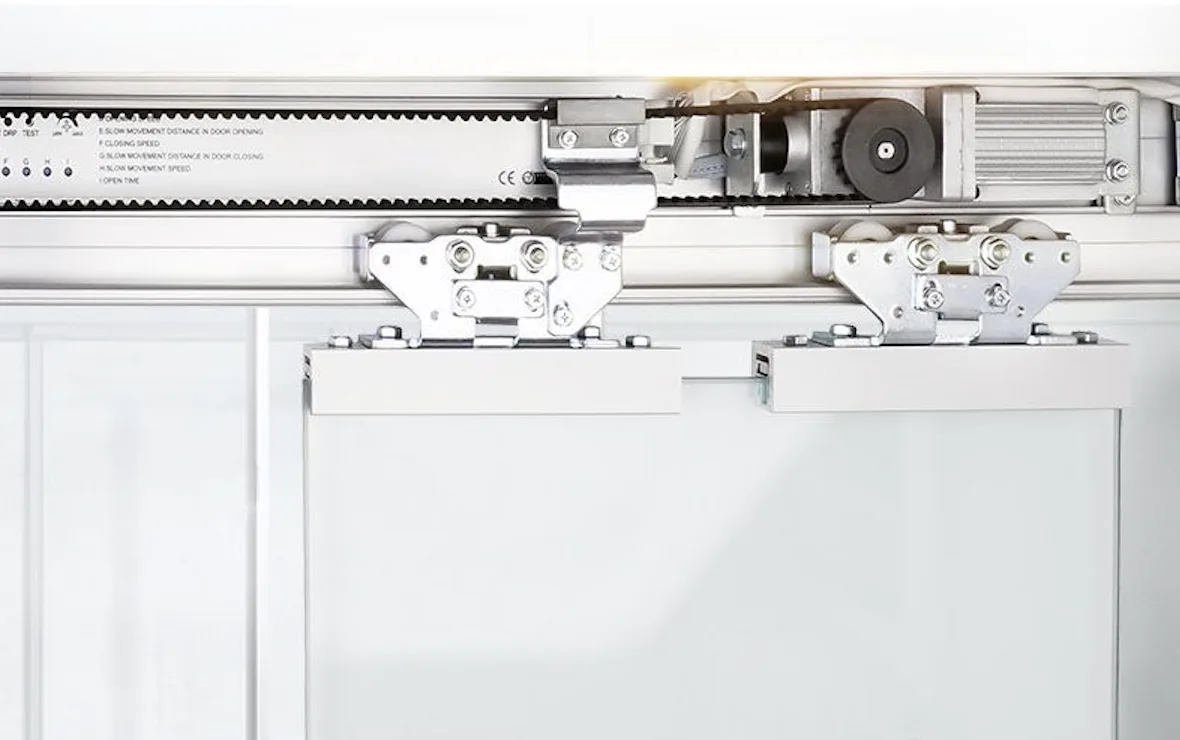
Key Advantages of Sliding Door Motors
-
Saves front and rear swing space
-
Supports high traffic volume
-
Quiet operation with brushless motor
-
Wide opening width for carts and wheelchairs
-
Clean modern appearance
Common Applications of Sliding Door Motors
-
Shopping malls
-
Supermarkets
-
Hospitals
-
Airports
-
Hotels
-
Office towers
The ADA accessibility guidance supports accessible entrances, and sliding doors are often selected because barrier-free movement is easier for wheelchairs and carts.
How Automatic Swing Door Motors Operate
A swing door motor automates a hinged door leaf. The motor uses an arm mechanism or concealed drive to push or pull the door open. After passage, the system closes the door at a controlled speed.
Swing door motors are frequently used in retrofit projects because many buildings already have hinged doors installed. Instead of replacing the full entrance frame, installers can add an operator to the existing door.
Key Advantages of Swing Door Motors
-
Lower renovation cost in many buildings
-
Suitable for single doors and narrow entries
-
Works with wood, aluminum, or steel doors
-
Easy integration with access control systems
-
Good option for offices and interior doors
Common Applications of Swing Door Motors
-
Offices
-
Schools
-
Clinics
-
Residential buildings
-
Accessible restroom entrances
-
Government facilities
The Occupational Safety and Health Administration (OSHA) promotes safe pedestrian routes and controlled door movement, which is relevant for powered swing doors.
Sliding Door Motor vs Swing Door Motor Comparison
| Feature | Sliding Door Motor | Swing Door Motor |
|---|---|---|
|
Door Motion |
Horizontal slide |
Hinged swing |
|
Space Efficiency |
High |
Needs swing area |
|
Retrofit Ease |
Medium |
High |
|
Traffic Capacity |
High |
Medium |
|
Visual Style |
Modern |
Traditional |
|
Best Use |
Public entrances |
Existing hinged doors |
Key conclusion: choose a sliding door motor for high traffic and limited space; choose a swing door motor for renovation projects or standard hinged door layouts.
How to Choose the Right Automatic Door Motor
Correct selection depends on structural conditions, user flow, and compliance needs. Evaluate these points before purchase:
-
Door leaf weight and width
-
Opening cycles per day
-
Indoor or outdoor installation
-
Required access control integration
-
Fire or emergency escape rules
-
Noise limits for hospitals or offices
-
Maintenance access availability
The NIOSH workplace safety resources note that public equipment reliability supports safer movement in shared environments. Reliable door motors reduce abrupt stops and uncontrolled closing.
Maintenance Tips for Sliding and Swing Door Motors
Preventive maintenance extends service life. Dust, poor alignment, and worn sensors often create more failures than the motor itself.
| Maintenance Task | Sliding Door Motor | Swing Door Motor |
|---|---|---|
|
Track Cleaning |
Important |
Not required |
|
Hinge Inspection |
Low |
Important |
|
Belt Check |
Important |
Not required |
|
Arm Tightening |
Low |
Important |
|
Sensor Test |
Important |
Important |
Recommended service intervals vary by traffic level. High-use entrances may need quarterly inspection.
For replacement planning, many buyers source door operator replacement motor or automatic swing door opener kits with matched controllers.
2026 Market Trend for Automatic Door Motors
Current demand trends include:
-
Brushless low-noise motors
-
Smart control with mobile diagnostics
-
Energy-saving standby modes
-
Contactless sensor activation
-
Retrofit swing door automation for aging buildings
The International Energy Agency continues to highlight building efficiency upgrades, and automated entrance systems increasingly align with smarter building management.
FAQ
1. What is the main difference between a sliding door motor and a swing door motor?
A sliding door motor moves the panel sideways on a track. A swing door motor rotates a hinged leaf inward or outward. Space layout usually determines the better option.
2. Which automatic door motor is better for hospitals?
Sliding door motors are often preferred for hospital main entrances because they allow stretcher movement and hands-free traffic flow. Swing door motors are common for internal rooms and accessible restrooms.
3. Can a swing door motor be installed on an existing manual door?
Yes. Many swing door operators are designed for retrofit use. Installers can automate an existing hinged door if the frame, hinges, and door condition are suitable.
4. How long does an automatic door motor last?
Service life depends on cycle volume, environment, and maintenance quality. Commercial brushless motors commonly operate for many years when sensors, tracks, and mechanical parts are serviced regularly.
5. Which motor type needs less space?
A sliding door motor usually needs less operating space because the panel moves sideways. A swing door motor requires a clear arc area in front of or behind the door leaf.