
A swing door motor is the drive unit that automates a hinged door by opening and closing the door leaf through controlled rotational movement. The operating principle is simple: a sensor, push plate, access control reader, or remote signal sends a command to the controller; the controller activates the motor; the motor drives an arm or internal gearbox; the hinged door opens smoothly and then closes safely after a preset hold-open time.
Swing door motors are common in offices, hospitals, schools, apartment buildings, and retrofit projects because existing manual hinged doors can often be automated without replacing the full entrance structure. According to the U.S. Department of Energy, efficient building access systems can help reduce conditioned air loss and improve facility operation. Buyers frequently compare swing door motor, automatic swing door opener, swing door operator, door automation system, automatic door spare parts, and commercial swing door motor.
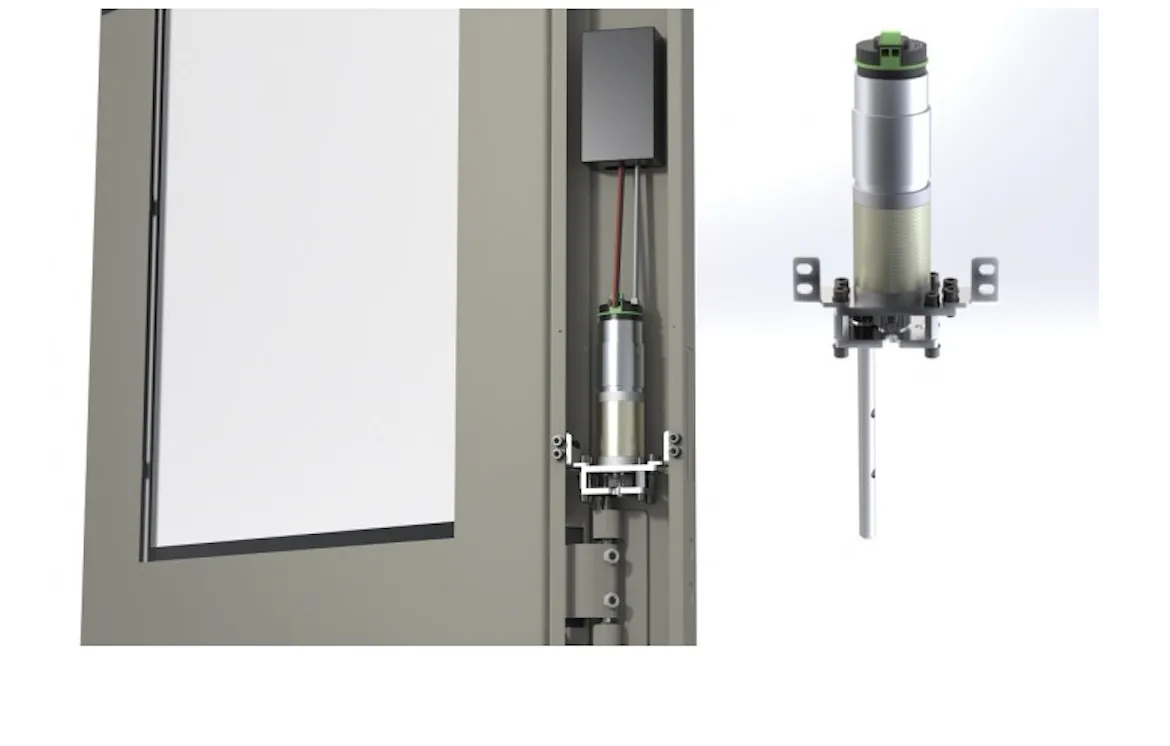
Swing Door Motor Definition and Core Working Principle
A swing door motor is an electromechanical operator installed above the door frame or concealed in the floor or transom. The motor creates torque that rotates the door leaf around hinges.
The complete operating cycle usually follows this sequence:
-
User approaches or sends command
-
Sensor or switch sends signal
-
Controller checks safety inputs
-
Swing door motor starts smoothly
-
Arm opens door to target angle
-
Door holds open briefly
-
Motor closes door with controlled speed
This process allows barrier-free and repeatable access.
| System Component | Main Function | Result |
|---|---|---|
|
Sensor / Switch |
Start signal |
Opens door |
|
Controller |
Motion logic |
Controls timing |
|
Swing Door Motor |
Produces torque |
Rotates door |
|
Arm Linkage |
Transfers force |
Moves leaf |
|
Safety Sensor |
Detects obstruction |
Prevents impact |
How the Swing Door Motor Starts Opening
When a radar sensor detects movement or a push button is pressed, the controller powers the swing door motor. Modern systems often use DC brushless or low-noise geared motors.
The controller does not apply full speed instantly. Soft-start programming increases torque gradually. Controlled acceleration reduces hinge stress, lowers noise, and improves user comfort.
The National Institute of Standards and Technology (NIST) highlights precision control in automated systems. Similar motion control is important in door automation because smooth starts improve reliability and reduce wear.
Many retrofit buildings choose automatic swing door opener kits for this reason.
How the Swing Door Motor Converts Rotation into Door Movement
The swing door motor usually drives a mechanical arm, sliding rail arm, or direct spindle mechanism. Motor rotation is converted into arc motion, causing the door leaf to swing inward or outward.
Common Transmission Methods
-
Articulated arm system
-
Slide track arm system
-
Concealed floor spring motor system
-
Heavy-duty gearbox arm system
| Transmission Type | Best Use | Main Advantage |
|---|---|---|
|
Articulated Arm |
Standard doors |
Easy installation |
|
Slide Track Arm |
Narrow corridors |
Reduced projection |
|
Concealed Floor Drive |
Premium entrances |
Clean appearance |
|
Gear Arm |
Heavy doors |
Higher torque |
Many contractors source swing door operator arm parts together with motors.
How the Swing Door Motor Closes Safely
After the programmed hold-open time expires, the controller commands the swing door motor to reverse or release controlled closing torque. The door returns to the closed position at a regulated speed.
Safety remains active during closing. If the system detects a person, wheelchair, or object in the path, the controller pauses or reopens the door.
The Occupational Safety and Health Administration (OSHA) promotes safe pedestrian routes and powered equipment practices. Controlled automatic door closing supports these safety principles in workplaces and public buildings.
Why Swing Door Motors Are Popular for Retrofit Projects
Swing door motors are widely used because many buildings already have hinged doors. Upgrading a manual door often costs less than replacing the entire entrance with a sliding system.
Main Retrofit Advantages
-
Uses existing frame in many cases
-
Lower construction disruption
-
Faster installation time
-
Compatible with access control readers
-
Suitable for interior doors
This makes swing door motors common in schools, clinics, offices, and apartment entrances.
Many property managers compare retrofit swing door motor solutions before renovation.
Key Swing Door Motor Performance Parameters
Correct motor selection should match door size and traffic volume.
| Parameter | Why It Matters |
|---|---|
|
Door Weight Capacity |
Ensures stable opening |
|
Opening Angle |
Matches passage needs |
|
Duty Cycle |
Handles frequent use |
|
Voltage |
Matches power supply |
|
Noise Level |
Important for hospitals |
|
Closing Force |
Safety compliance |
The ADA accessibility guidance is relevant because automatic doors should allow accessible movement and manageable opening forces where applicable.
Common Swing Door Motor Problems and Causes
Many faults are linked to installation or maintenance rather than motor failure.
Frequent Issues
-
Door opens slowly — low voltage or incorrect settings
-
Door slams shut — closer calibration problem
-
Door stops midway — obstruction detection triggered
-
Motor noise increases — worn gearbox or loose arm
-
Door drifts open — hinge alignment issue
Routine inspection should include hinge lubrication, arm tightening, sensor tests, and speed verification.
Service teams often purchase automatic door replacement motor sets with controllers and arms.
How to Choose the Right Swing Door Motor
Use this selection method:
-
Office interior door: standard low-noise operator
-
Hospital room door: quiet precision model
-
Exterior steel door: higher torque system
-
Apartment access door: card-reader compatible model
-
High-traffic school entrance: heavy-duty operator
Key conclusion: the correct swing door motor depends on door mass, daily cycles, opening direction, and access control requirements.
The International Energy Agency continues to emphasize smarter buildings, and automatic access systems increasingly connect with broader energy management platforms.
FAQ
1. How does a swing door motor open a door?
A swing door motor receives a signal from a sensor or switch, rotates an arm mechanism, and moves the hinged door leaf through an arc. The controller manages speed and hold-open time.
2. Is a swing door motor better than a sliding door motor?
Each type suits different layouts. Swing door motors are often better for retrofit hinged doors, while sliding door motors are better for high-traffic entrances and limited front clearance.
3. Can a manual hinged door be converted to automatic?
Yes. Many existing hinged doors can be upgraded with a swing door motor if the frame, hinges, and door condition are suitable for automation.
4. Why does a swing door motor stop before fully closing?
The system may detect an obstruction, use slow-close programming, or have incorrect sensor alignment. Closing speed and safety settings should be checked first.
5. How long does a swing door motor last?
Service life depends on cycle frequency, environment, installation quality, and maintenance. Commercial-grade units commonly operate for many years when hinges, arms, and sensors are serviced regularly.