
The essential components of a heavy duty automatic sliding door operator system are crucial for its functionality and efficiency. Each part, including the door operator components, works in harmony to ensure smooth operation. Knowledge of these components aids in effective operation and maintenance. For instance, sliding door sensors play a vital role in detecting movement, allowing for seamless access. Additionally, an automatic sliding door operator system with remote control enhances convenience for users. Familiarity with these key components of electric sliding door systems, including what sensors are used in automatic sliding door operators, enhances user experience and safety.
Key Takeaways
- Understand the key components of automatic sliding doors, including door panels, tracks, motors, and sensors, to enhance functionality and safety.
- Choose the right materials for door panels, such as fiberglass for energy efficiency or steel for durability, to optimize performance.
- Regularly maintain tracks and rollers by lubricating them at least twice a year to ensure smooth operation and prevent wear.
- Select appropriate motors based on door weight and traffic needs, as different motors offer unique advantages for various applications.
- Incorporate safety features like motion sensors and emergency stop buttons to protect users and comply with safety standards.
Door Panels
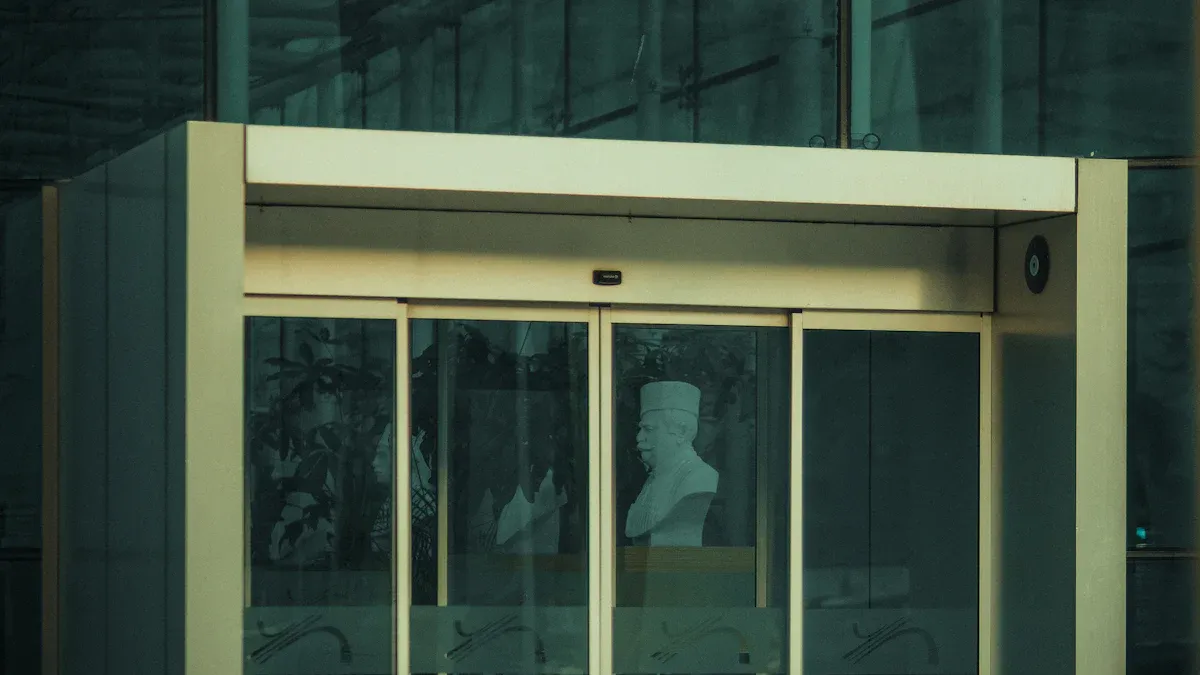
Door panels serve as the primary barrier in automatic sliding door systems. They not only provide access but also contribute to the overall aesthetic and functionality of the entrance. The choice of materials for these panels significantly impacts their durability, energy efficiency, and maintenance requirements.
Common materials used in the construction of automatic sliding door panels include:
| Material Type | Specification |
|---|---|
| Steel Type | Galvannealed |
| Door Thickness | 1-3/4 Inch |
| Core Material | Full Body Insulated Polystyrene |
| Finish | Baked On Prime Coat Finish |
| Usage Frequency | Heavy Duty, SDI Level 2, 18 Gauge Steel Sheets |
Steel panels are popular due to their strength and resistance to wear. However, they require insulation to enhance energy efficiency. The insulation capability of different materials varies, affecting the overall performance of the door system. For instance, fiberglass doors offer high energy efficiency due to their low thermal conductivity, while steel doors need an insulated foam core to achieve similar results.
The insulation properties of various materials can be summarized as follows:
| Material | R-value | Insulation Capability |
|---|---|---|
| Fiberglass | 6 | Highly energy-efficient due to low conductivity |
| Steel | 5-6 | Offers less insulation unless insulated foam core |
| Wood | N/A | Natural insulation but prone to moisture issues |
- Fiberglass doors are popular for their low conductivity and high energy efficiency.
- Steel doors require an insulated foam core to improve insulation.
- Wooden doors need to be thicker for better R-value, which may not be practical.
Selecting the right door panel material is essential for optimizing the performance of door operator components. Proper insulation not only enhances energy efficiency but also contributes to the longevity of the door system.
Tracks and Rollers
Tracks and rollers play a vital role in the operation of automatic sliding doors. They facilitate smooth movement, ensuring that the door opens and closes efficiently. The design and material of these components significantly influence the overall performance of the door operator system.
Load Capacities
Understanding the load capacities for tracks and rollers is essential for selecting the right components. The following table outlines typical specifications for single and double-opening sliding doors:
| Gate Sliding Modes | Single-Opening | Double-Opening |
|---|---|---|
| Gate Leaf Weight | ≤1*155 kg | ≤2*145 kg |
| Gate Leaf Width | 600-1200 mm | 500-1100 mm |
| Opening Speed | 150-600 mm/s (Adjustable) | 150-550 mm/s (Adjustable) |
| Closing Speed | 120-550 mm/s (Adjustable) | 120-500 mm/s (Adjustable) |
| Motor | 24V 60/100W brushless DC motor | N/A |
| Hold Open Time | 0-9 seconds (Adjustable) | N/A |
| Special Function | Security, Hermetic | N/A |
| Voltage | AC220V 50Hz-60Hz | N/A |
| Operating Temperature | -20°C~60°C | N/A |
Materials Used
The materials chosen for tracks and rollers impact their durability and performance. Common materials include:
- High-quality polymers: These outperform traditional materials, providing better performance and longevity.
- Metal rollers: While durable, they can be noisy and may wear out aluminum rails, requiring regular lubrication.
- Plastic rollers: These often lack dimensional stability and can fail under stress, making them less suitable for heavy-duty applications.
Maintenance Recommendations
To ensure optimal performance, regular maintenance of tracks and rollers is crucial. Recommended practices include:
- Lubricate the tracks and rollers at least twice a year.
- Increase lubrication frequency if the door experiences heavy usage.
By understanding the importance of tracks and rollers, users can enhance the efficiency and longevity of their automatic sliding door systems. Proper selection and maintenance of these door operator components contribute significantly to the overall functionality of the system.
Motor and Drive Mechanism
The motor and drive mechanism serves as the heart of an automatic sliding door operator system. This component is responsible for the movement of the door panels, ensuring they open and close smoothly. Various types of motors are commonly used in these systems, each offering unique advantages:
- Electromechanical Motors: These motors operate using an electric motor and gearbox. They are suitable for standard and moderately heavy doors, providing reliable performance.
- Electrohydraulic Motors: Utilizing hydraulic fluid for movement, these motors excel with heavy doors. They deliver smooth operation and precise control, making them ideal for high-traffic areas.
- Linear Motors: This advanced technology features direct drive capabilities. Linear motors are known for their quiet operation and high efficiency, enhancing user experience.
The choice of motor impacts the overall efficiency and effectiveness of the door operator components. Proper selection ensures that the system meets the specific demands of the installation environment.
Common Maintenance Issues
Regular maintenance of the motor and drive mechanism is essential for optimal performance. The following table outlines common issues, their possible causes, and recommended solutions:
| Problem Description | Possible Causes | Solutions |
|---|---|---|
| Door Fails to Open or Close Automatically | Power supply is disconnected or unstable; Sensor is not detecting motion; Control panel is malfunctioning; Safety beam is blocked or misaligned | Ensure the power is properly connected; Clean the motion sensor; Inspect the control panel; Make sure nothing is obstructing the safety beam |
| Door Opens or Closes Too Slowly | Speed settings are too low; Track or rollers are dirty or worn; Motor is underperforming | Adjust speed settings; Clean and lubricate track and rollers; Inspect the motor and replace if needed |
| Door Produces Excessive Noise | Loose hardware or misaligned rollers; Worn bearings or guide wheels; Lack of lubrication | Tighten bolts; Replace worn components; Apply lubricant to moving parts |
By addressing these common maintenance issues, users can prolong the lifespan of the motor and ensure the door operates efficiently. Understanding the motor and drive mechanism is crucial for maintaining the overall functionality of automatic sliding door systems.
Control Unit
The control unit acts as the brain of an automatic sliding door operator system. It oversees the entire operation, ensuring that the door moves smoothly along its track. This component integrates safety features, such as sensors, to detect nearby obstacles, enhancing the overall safety and efficiency of the system.
The control unit performs several essential functions:
| Function Type | Description |
|---|---|
| Basic Functions | Automatic operation, hold-open, closed, and half-open modes to meet customer needs. |
| Extended Functions | Multiple interfaces for access control systems, enhancing safety and security. |
| Safety Features | Integration with safety beam photocells, electric locks, and sensors for obstacle detection. |
| Operational Features | Utilizes advanced technology for reliable operation and increased power output for large doors. |
Programmable control units further enhance the flexibility of these systems. They allow for quick management of operations and can be customized to meet specific needs. Features include:
- Dual Microcontrollers: These enable rapid response to issues as they arise.
- Customizable Settings: Users can adjust door speeds and safety features according to their requirements.
- Integration with Sensors: This facilitates connections with various sensors, improving functionality.
The control unit also interfaces seamlessly with sensors and activation devices. For example, models like the ULTIMO utilize dual technology, combining microwave and infrared capabilities. This integration ensures flexible safety features and advanced presence detection, making it ideal for high-traffic environments.
Moreover, modern control units can connect with building automation systems (BAS). This coordination allows for the management of various systems, such as HVAC and lighting, from a common platform. Data points like temperatures and occupancy signals can be shared across systems, enhancing responsiveness and intelligence.
Sensors and Activation Devices
Sensors and activation devices are critical components of automatic sliding door operator systems. They enhance user convenience and ensure safe operation. Various types of sensors detect movement and trigger the door’s opening mechanism.
The following table outlines common sensor types used in these systems:
| Sensor Type | Description | Pros | Cons |
|---|---|---|---|
| Infrared Sensors | Detects movement by sensing changes in heat from a person’s body. | Reliable for detecting people; inexpensive | Prone to false positives; may miss non-heat objects. |
| Pressure Sensors | Activated by force applied to a mat or surface in front of the door. | Simple and effective; ideal for specific traffic flow. | Less sensitive to non-human objects; requires maintenance. |
| Radar-Based Sensors | Emits radar waves to detect objects or people approaching the door. | Fast activation; detects a wide range of objects. | More expensive; may detect irrelevant movements. |
Activation devices also play a significant role in enhancing accessibility. They allow users to open doors with minimal effort, catering to individuals with mobility challenges. The following table summarizes different activation devices and their accessibility features:
| Activation Device Type | Description | Accessibility Feature |
|---|---|---|
| Motion Sensors | Detects movement to open doors automatically | No physical effort required |
| Push Buttons | Requires pressing to activate doors | Can be placed within reach |
| Touchless Technologies | Opens doors without contact | Ideal for users with mobility challenges |
In addition, non-contact proximity switches enable users to activate doors simply by approaching. This feature is particularly beneficial for individuals using crutches or wheelchairs. By integrating these sensors and activation devices, automatic sliding door operator systems enhance both functionality and user experience.
Safety Features
Safety features are essential in automatic sliding door operator systems. They protect users and ensure smooth operation. Various safety mechanisms work together to minimize the risk of injury and enhance accessibility.
The following table outlines key safety features commonly implemented in these systems:
| Safety Feature | Description |
|---|---|
| Motion Sensors | Detect movement in the door’s path to stop or reverse motion if an obstruction is sensed. |
| Presence Sensors | Prevent the door from closing on individuals standing in the doorway. |
| Safety Beams | Use infrared sensors to stop or reverse the door if the beam is interrupted. |
| Pressure Sensors | Detect resistance to halt or change direction of the door when encountering an obstacle. |
| Emergency Stop Button | Allows users to immediately halt the door’s operation in emergencies. |
| Slow Start and Stop Functionality | Ensures smooth operation to reduce the risk of users being caught off guard. |
| Battery Backup Systems | Maintain door operation during power outages for safety and accessibility. |
| Low Energy Mode | Reduces opening and closing force for environments with limited mobility. |
| Compliance with Standards | Adheres to safety standards like ANSI/BHMA A156.10 to ensure safety criteria are met. |
| Diagnostic and Monitoring Systems | Continuously assess performance and detect issues for timely maintenance. |
Safety sensors play a crucial role in reducing the risk of injury. They detect individuals in the door’s path, preventing the door from closing on them. Properly adjusted sensors significantly enhance safety. However, improper adjustments can lead to accidents. Testing has shown that incorrect detection times can result in dangerous situations.
In addition to sensors, compliance with international safety standards is vital. The following table summarizes key standards that automatic sliding door systems must meet:
| Standard/Code | Requirement | Description |
|---|---|---|
| ANSI/BHMA A156.10 | Break Away Device | Allows egress under emergency conditions by permitting the door to swing open manually. |
| NFPA 101 | Swing-out Feature | Requires doors to swing open fully when force is applied, with exceptions for certain occupant loads. |
| International Building Code (IBC) | Power Operated Doors | Mandates that doors must open fully in the direction of egress, without exceptions for certain loads. |
By integrating these safety features, automatic sliding door operator systems enhance user protection and ensure compliance with safety regulations.
Power Supply
The power supply is a critical component of an automatic sliding door operator system. It provides the necessary energy for the door operator components to function effectively. Understanding the power requirements ensures reliable operation and longevity of the system.
Voltage and Current Requirements
Most automatic sliding door systems operate on standard voltage levels. The following table outlines typical voltage and current specifications:
| Voltage | Frequency | Phase | Current Draw |
|---|---|---|---|
| 120VAC | 60 Hz | Single Phase | ~1 amp |
| 220VAC | 50 Hz | N/A | N/A |
These specifications indicate that systems can operate on either 120VAC or 220VAC, depending on regional standards. The current draw is essential for determining the capacity of the power supply.
Backup Power Solutions
In case of power outages, backup power supplies ensure continuous operation of automatic sliding doors. The following points highlight how these systems work:
- Uninterruptible Power Supply (UPS): These systems consist of a battery and an inverter, providing necessary power during outages.
- Automatic Switchover: The UPS detects power loss and switches to battery power almost instantly.
- Battery Duration: The length of backup power depends on battery capacity and usage frequency.
- Continuous Charging: The UPS keeps the battery charged while in use, ensuring readiness for future outages.
Common Power Supply Types
Different types of power supplies are used in automatic sliding door operator systems worldwide. The table below summarizes the most common specifications:
| Specification | Details |
|---|---|
| Voltage Range | 12–24 V DC or AC |
| Current Consumption | 20 mA to 200 mA |
| Frequency Compatibility | 50 Hz and 60 Hz |
Selecting the appropriate power supply is vital for the performance of door operator components. Proper voltage and current ensure that the system operates smoothly and efficiently.
In summary, the automatic sliding door operator system comprises several key components, each serving a distinct function:
| Component | Function |
|---|---|
| Door Panels | Visible components that slide horizontally to open and close the entrance. |
| Tracks and Rollers | Guides for the movement of door panels, ensuring smooth operation. |
| Motor and Drive Mechanism | Provides the force to move the door panels along the tracks, converting rotational to linear motion. |
| Control Unit and Sensors | Manages the operation of the motor and receives input from sensors to control door actions. |
| Activation Devices | Triggers the opening or closing of doors based on user interaction or environmental conditions. |
| Safety Features | Prevents accidents with sensors for obstructions and emergency stop buttons. |
| Power Supply | Supplies the necessary power for the system to operate effectively. |
Understanding these door operator components enhances maintenance and performance. Regular maintenance ensures optimal sensor function, crucial for smooth door operation. Identifying and addressing potential issues early can prevent costly repairs. Enhanced safety and minimized disruptions improve overall performance.
FAQ
What is the average lifespan of an automatic sliding door operator?
The average lifespan of an automatic sliding door operator ranges from 10 to 20 years, depending on usage, maintenance, and environmental conditions.
How often should I maintain my automatic sliding door system?
Regular maintenance should occur at least twice a year. Frequent inspections ensure optimal performance and address potential issues before they escalate.
Can I install an automatic sliding door myself?
While some individuals may attempt DIY installation, hiring a professional is recommended. Proper installation ensures safety, functionality, and compliance with local regulations.
What types of sensors are used in automatic sliding doors?
Common sensors include infrared, pressure, and radar-based sensors. Each type offers unique advantages for detecting movement and ensuring safe operation.
Are automatic sliding doors energy-efficient?
Yes, automatic sliding doors can enhance energy efficiency. They minimize air leakage and reduce heating and cooling costs when properly sealed and insulated.