
The global automatic door market is experiencing a significant transition towards high-intelligence, energy-efficient systems. As of 2026, the market for Automatic Sliding Doors is projected to grow at a CAGR of 5.2%, driven by increasing demand in the commercial and healthcare sectors (Source: Mordor Intelligence). Modern systems now integrate sophisticated microwave motion sensors and active infrared safety beams to optimize traffic flow and thermal insulation. By minimizing the “door-open” cycle, these technologies contribute to a 10-15% reduction in HVAC energy loss. This article provides a technical analysis of how Automatic Door Operators and advanced sensor arrays ensure compliance with international safety standards, such as EN 16005 and ANSI A156.10, while enhancing user accessibility and building security.
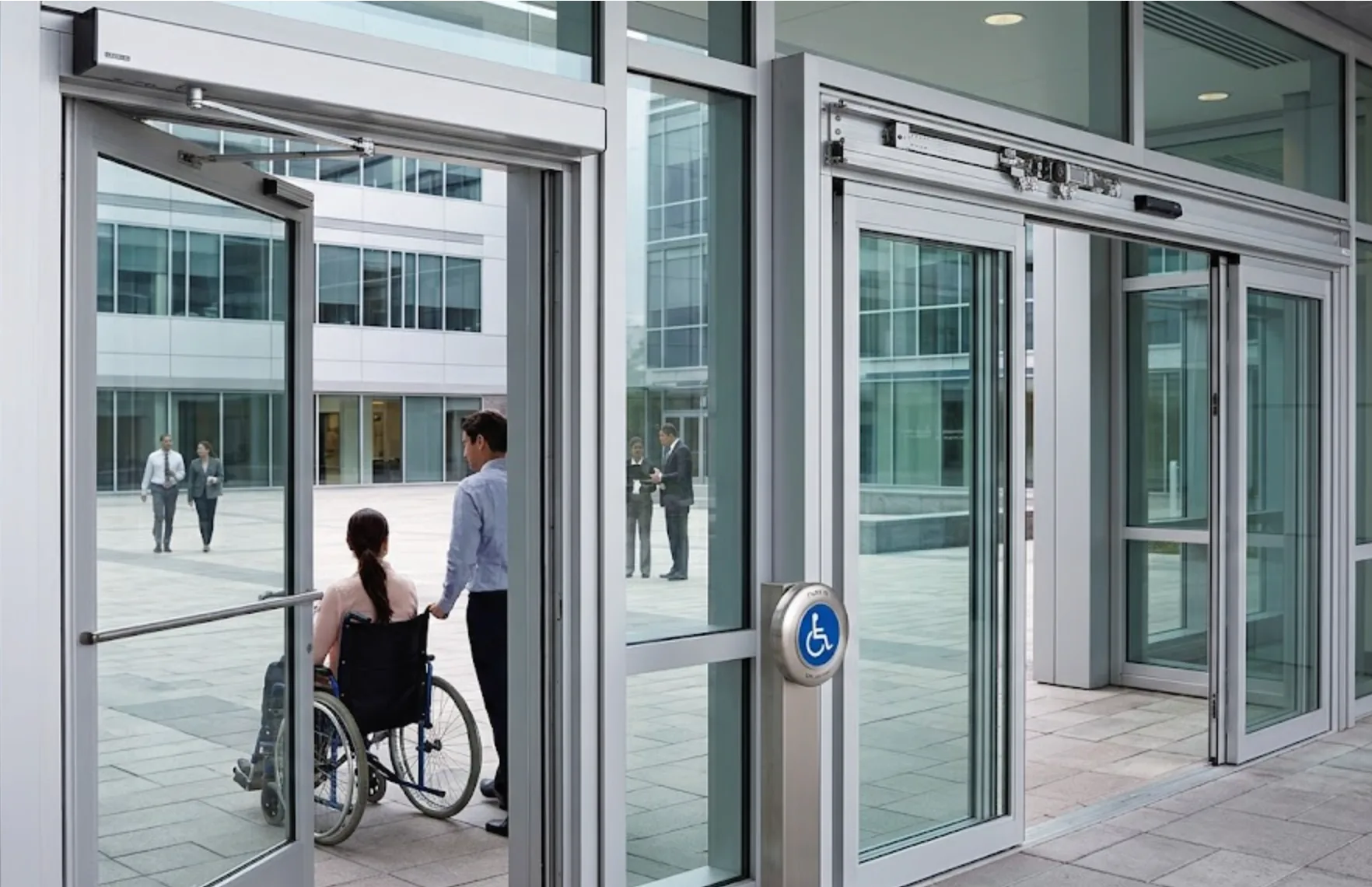
How Do Automatic Door Operators Drive Commercial Building Accessibility?
An Automatic Door Operator is an electromechanical device that powers the opening and closing of a door wing upon receiving a trigger signal. In 2026, the industry has shifted from traditional brushed DC motors to Brushless DC (BLDC) motors due to their higher torque-to-weight ratio and reduced maintenance requirements. These operators are critical for meeting the Americans with Disabilities Act (ADA) standards and European accessibility regulations. Key technical components include the microprocessor controller, which manages the speed profiles—acceleration, braking, and latching—and the encoder, which monitors the exact position of the door leaf. Compared to manual doors, automatic systems eliminate physical barriers for elderly users and individuals with physical impairments, ensuring inclusive infrastructure design.
What Are the Key Technical Specifications of High-Performance Automatic Sliding Doors?
High-performance Automatic Sliding Doors are characterized by their “Intelligent Control Systems” and “Heavy-Duty Track Profiles.” A typical commercial-grade system supports leaf weights ranging from 100kg to over 250kg. The semantic definition of a high-performance door includes a duty cycle capable of handling over 1 million opening/closing operations without mechanical failure. Modern track designs utilize high-strength aluminum alloys with vibration-dampening rubber gaskets to reduce noise levels to below 50 decibels (dB).
Technical Specification Comparison for Sliding Door Systems:
| Feature | Standard Commercial Grade | Heavy Duty Industrial Grade |
|---|---|---|
|
Max Door Weight (Double) |
100kg + 100kg |
250kg + 250kg |
|
Motor Type |
24V BLDC Motor |
High-Torque AC or 36V BLDC |
|
Opening Speed |
0.5 – 0.7 m/s (Adjustable) |
0.8 – 1.2 m/s (Adjustable) |
|
Safety Sensors |
Infrared Motion + Safety Beam |
Dual Microwave/Infrared + Pressure Mat |
|
Backup Battery |
Standard 24V UPS |
High-Capacity Lithium-Ion |
How Does Microwave Radar Technology Improve Automatic Door Sensor Accuracy?
Microwave Radar Technology is a motion-detection method that utilizes the Doppler Effect to identify moving objects within a specific detection field. Unlike Passive Infrared (PIR) sensors which detect heat signatures, Microwave Sensors emit high-frequency signals and measure the frequency change of the reflected signal. This allows for superior detection of rapid movement and ignores static thermal changes, such as sunlight hitting a floor. For Automatic Door Sensors, the primary advantage of microwave technology is its “directional detection” capability, which ignores traffic moving away from the door, thereby preventing unnecessary opening cycles and conserving internal building temperatures.
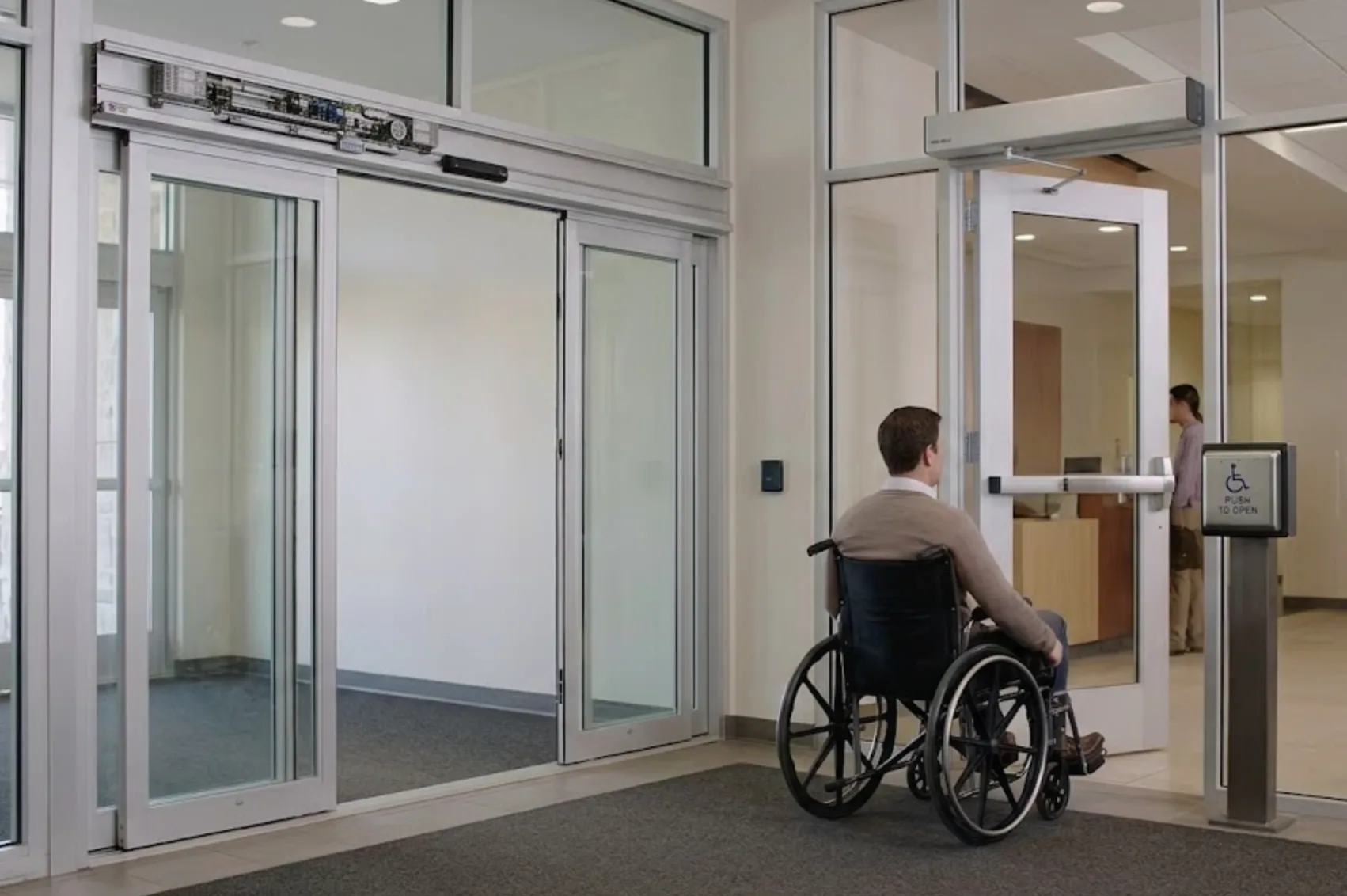
Why Is Compliance with EN 16005 Essential for Automatic Swing Door Safety?
Safety in Automatic Swing Door systems is governed by strict international safety protocols, most notably EN 16005. This European standard specifies requirements regarding the design and testing of automatic pedestrian doors to prevent crushing, shearing, and impact accidents. A compliant system must integrate “Low Energy” or “Full Power” safety modes. In “Full Power” mode, the installation of safety sensors on the leading edge of the door leaf is mandatory. These sensors create a “protection curtain” that stops or reverses the door movement if an obstacle is detected within the swing path. Statistical data indicates that buildings adhering to EN 16005 experience a 40% reduction in door-related liability claims compared to non-standardized installations.
How Can Automatic Hospital Doors Maintain Sterile Environments in Healthcare Facilities?
Automatic Hospital Doors are specialized hermetic or semi-hermetic systems designed to control airflow and prevent cross-contamination. In surgical suites and intensive care units (ICUs), these doors must maintain a specific pressure differential between rooms. The “Hermetic Sealing” technology involves a unique track mechanism that lowers and presses the door leaf against the frame in the final closing stage, creating a gasket seal. Material selection is also critical; surfaces are typically made of high-pressure laminates (HPL) or 304/316 stainless steel to withstand frequent chemical disinfection. According to the World Health Organization (WHO), hands-free entry systems are a primary defense mechanism against hospital-acquired infections (HAIs) (Source: WHO Best Practices).
What Is the Installation Process for an Automatic Telescopic Sliding Door?
The installation of an Automatic Telescopic Sliding Door requires precise mechanical alignment to ensure the synchronized movement of multiple door leaves. The following steps summarize the professional installation workflow:
1.Site Measurement: Verify the clear opening width and ensure the structural header can support the weight of the telescopic track.
2.Track Installation: Level and secure the aluminum track. Telescopic tracks feature a double-rail design to allow the secondary leaf to slide faster than the primary leaf.
3.Leaf Mounting: Attach the door leaves to the specialized carrier rollers. The gear ratio in the timing belt must be accurately calibrated for simultaneous arrival at the “fully open” position.
4.Wiring and Integration: Connect the Automatic Door Operator to the power supply and safety sensors.
5.Parameter Tuning: Program the opening/closing speeds and hold-open times via the digital function selector.
6.Safety Commissioning: Perform a “Walk-Test” to ensure sensors detect pedestrians at all angles as required by safety standards.
How Does Thermal Break Technology Enhance Energy Performance in Automatic Doors?
Thermal Break Technology in Automatic Sliding Door frames involves the insertion of a non-conductive material, such as reinforced polyamide, between the interior and exterior aluminum profiles. This breaks the “thermal bridge,” significantly reducing heat transfer. In cold climates, this prevents condensation on the interior frame and reduces the heating load of the building. Current energy modeling shows that using thermally broken automatic doors in a commercial lobby can improve the building’s overall U-value (thermal transmittance) by up to 25%, contributing to LEED (Leadership in Energy and Environmental Design) certification points.
FAQ
How can I troubleshoot an automatic door that remains open?
The most common cause for an Automatic Sliding Door staying open is a triggered safety sensor. Check the safety beam or infrared sensor for dust, obstructions, or misalignment. If the sensor LED is blinking, it indicates an active detection or a technical fault that requires a reset of the Automatic Door Operator.
What is the average lifespan of an automatic door motor?
A high-quality 24V BLDC motor used in professional Automatic Door Operators typically has a lifespan of 10 to 15 years, or approximately 1 to 2 million cycles, provided that regular preventive maintenance—such as track cleaning and belt tensioning—is performed annually.
Are automatic swing doors compatible with fire alarm systems?
Yes, modern Automatic Swing Doors are designed to interface with building fire alarm systems. Upon receiving a fire signal, the door operator can be programmed to either “Fail-Safe” (unlock and allow manual opening) or “Fail-Secure” (close and latch to act as a fire barrier), depending on local fire safety codes and exit route requirements.
How do telescopic doors differ from standard sliding doors?
The primary difference is the space efficiency. An Automatic Telescopic Sliding Door uses two or three smaller leaves that overlap when opening. This allows for a much wider clear opening (up to 30% more) in narrow hallways or storefronts where side-room for a single large sliding leaf is unavailable.
Which sensors are best for preventing door contact with pedestrians?
Active Infrared (AIR) sensors are the industry standard for preventing contact. Unlike microwave sensors that detect motion, AIR sensors detect presence. They create a “curtain” of infrared light in the door’s threshold. If the light beam is broken by a stationary person or object, the Automatic Door Sensors will prevent the door from closing.