
When specifying automatic door accessories for commercial buildings, healthcare facilities, or retail environments, making informed decisions directly impacts safety, accessibility, and long-term operational costs. According to ANSI/BHMA A156.10 standards, power-operated pedestrian doors must meet rigorous safety and performance criteria to protect public welfare.
This comprehensive guide presents 10 expert tips to help architects, contractors, and facility managers navigate the complex landscape of automatic door accessories manufacturers and select components that ensure compliance, reliability, and optimal performance.
What Are Automatic Door Accessories and Why Do They Matter?
Automatic door accessories encompass the complete ecosystem of components that enable automated door operation beyond the basic door panel. These include activation sensors, safety devices, control systems, drive motors, guide rails, and backup power systems.
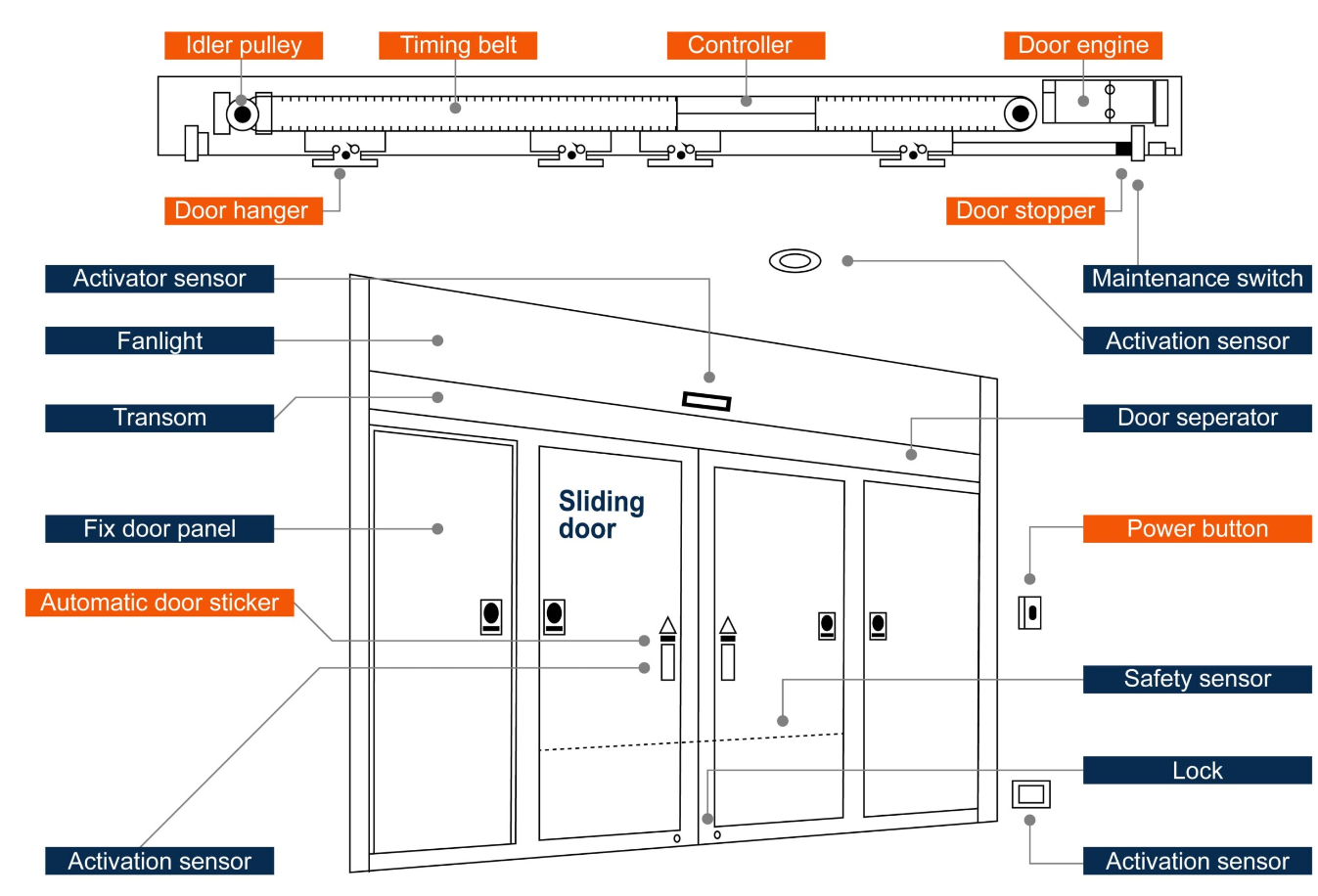
Figure 1: Complete automatic door system components including sensors, controllers, and drive mechanisms.
The performance of your automatic door system depends entirely on the quality and compatibility of these accessories. Substandard components can result in safety hazards, frequent maintenance, and non-compliance with accessibility regulations such as the ADA Standards for Accessible Design
.
Tip 1: How Do You Verify ANSI/BHMA A156.10 Compliance for Automatic Door Accessories?
ANSI/BHMA A156.10 is the primary American National Standard governing power-operated pedestrian doors. When evaluating automatic door accessories, demand documented compliance with this standard from your supplier.
Key compliance requirements include:
| Safety Feature | Requirement | Purpose |
|---|---|---|
| Entrapment Protection | Door must open to 80° in minimum 1.5 seconds with specified force ranges | Prevents injury during operation
|
| Knowing Act Devices | Minimum 5-second hold-open time after activation | Ensures safe passage for all users |
| Presence Sensors | Monitored before each closing cycle | Prevents closure on stationary objects |
| Signage | 1/2-inch minimum letter height, visible from both sides | Clear user communication |
Expert Insight: Request third-party test reports and certification labels. Reputable automatic door accessories manufacturers provide comprehensivedocumentation proving their products meet or exceed ANSI/BHMA standards.Tip 2: What Sensor Technologies Should You Prioritize in Modern Automatic Door Systems?
Sensor selection determines both safety and user experience. Contemporary automatic sliding door accessories utilize multiple detection technologies working in concert:
Motion Sensors (Microwave/Radar)
-
Detect approaching movement using Doppler effect
-
Ideal for high-traffic retail and transportation hubs
- Effective range: typically 8-12 feet from door center
Infrared Presence Sensors
-
Detect stationary heat signatures (human body temperature)
-
Critical for safety zones where people may pause
- Required by ANSI/BHMA for entrapment prevention
Pressure-Sensitive Control Mats
-
Floor-mounted activation and safety devices
-
Constructed with slip-resistant rubber-like materials
-
Maximum exposed edge thickness: 1/2 inch per ANSI standards
Combination Systems Modern installations employ redundant sensor arrays—motion sensors for activation and presence sensors for safety zones—to minimize false triggers and missed detections.
Tip 3: How Can You Evaluate the Durability of Automatic Door Accessories Manufacturers?
Not all automatic door accessories manufacturers maintain equivalent quality standards. Use this evaluation framework:
Certification Authority
-
Look for BHMA (Builders Hardware Manufacturers Association) certification
-
Verify products undergo laboratory testing and factory audits
Cycle Testing Requirements
-
Grade 1 commercial hardware: minimum 500,000 operational cycles
-
Grade 2 hardware: 250,000 cycles for light commercial use
Material Specifications
-
Stainless steel components for corrosion resistance
-
Aluminum alloys for weight reduction without strength compromise
-
UL-listed electrical components for safety compliance
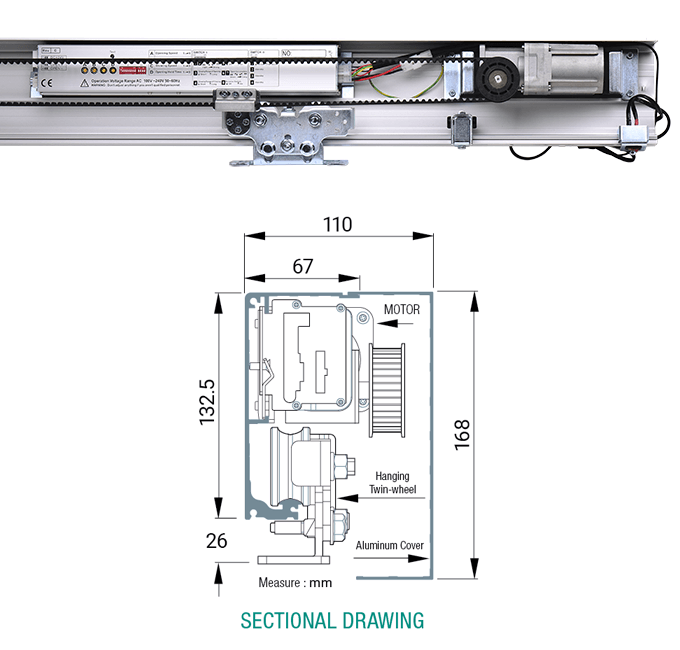
Figure 2: Technical sectional drawing showing motor, timing belt, and pulley system specifications.
Tip 4: What Are the Critical Safety Zones for Different Automatic Door Types?
Understanding safety zone configurations prevents liability issues and ensures code compliance:
Swinging Door Safety Zones
-
Primary Safety Zone: Extends minimum 5 inches beyond leading edge when open
-
Secondary Activating Zone: Additional 55 inches from leading edge for egress/ingress doors
-
Width Requirements: Equal to clear door opening minus maximum 5 inches from each side
Sliding Door Safety Zones
-
Activating Mat Length: Minimum 43 inches exposed length
-
Width Specification: Clear opening width minus maximum 10 inches total (5 inches per side)
-
Deactivation Point: Within 6 inches of fully closed position
Folding Door Configurations
-
Back Check Timing: Opening to back check position minimum 1.5 seconds
-
Closing Speed Maximum: 1 foot/second (287 mm/second) to latch check
-
Breakaway Force: Maximum 50 lbf (222 N) applied 1 inch from lock stile edge
Tip 5: Why Should You Prioritize ADA Compliance in Automatic Door Selection?
The Americans with Disabilities Act (ADA) and ICC A117.1 establish specific requirements for automatic and power-assisted doors that differ from manual door standards
:
Clear Opening Width Requirements
-
Minimum 32 inches clear width in both power-on and power-off modes
-
Measured with all door leaves in open position
Force Limitations
-
Low-energy doors (A156.19): Maximum 15 lbf (67 N) to prevent opening/closing at 12 mm from latch edge
-
Full-power doors (A156.10): Specific force ranges based on door weight and configuration
Timing Specifications
-
Doors must remain fully open minimum 5 seconds after knowing act device release
-
Additional 1 second per foot when activation device exceeds 12 feet from door center
Tip 6: What Control System Features Indicate Professional-Grade Automatic Door Accessories?
Advanced control systems distinguish commercial-grade automatic door accessories from residential alternatives:
Microprocessor-Based Controllers
-
Precise speed and timing adjustments
-
Diagnostic capabilities for maintenance alerts
-
Integration with building management systems (BMS)
Safety Circuit Monitoring
-
Continuous monitoring of safety sensors before each closing cycle
-
Fault detection mechanisms that disable operation upon sensor failure
Adjustable Parameters
-
Opening and closing speed profiles
-
Hold-open time customization (1.5 seconds minimum per ANSI)
-
Delayed activation settings for specific applications
Tip 7: How Do You Calculate the Right Motor Specifications for Your Automatic Door?
Motor selection depends on door weight, dimensions, and usage frequency:
Force Requirements by Door Type
| Door Configuration | Maximum Force to Prevent Movement | Measurement Point |
|---|---|---|
| Swinging Doors (last 10° of opening) | 40 lbf (180 N) | 1 inch from leading edge
|
| Sliding Doors (any closing point) | 30 lbf (133 N) | Leading edge |
| Folding Doors (fully open to latch check) | 30 lbf (133 N) | Leading edge of FX panel
|
Power Considerations
-
Low-voltage transformer systems (typically 24V DC) for safety
-
Battery backup systems for critical applications (hospitals, airports)
-
Energy-efficient standby modes reducing power consumption
Tip 8: What Installation Factors Affect Automatic Door Accessories Performance?
Even premium components fail when improperly installed. Professional installation considerations include:
Certified Installer Requirements
-
ANSI/BHMA A156.10 mandates trained installation personnel
-
Improper installation voids warranties and creates liability exposure
Environmental Factors
-
Temperature extremes affecting sensor accuracy
-
Humidity and moisture protection for electrical components
-
Vibration isolation for high-traffic environments
Integration with Fire Safety Systems
-
Automatic operators on fire door assemblies must comply with UL 10C or NFPA 252 standards
-
Smoke detector integration for emergency egress protocols
Tip 9: How Should You Plan Maintenance for Long-Term Automatic Door Reliability?
Proactive maintenance extends system lifespan and ensures continuous compliance:
Monthly Inspection Protocol
-
Visual inspection of all safety sensors and control mats
-
Testing of activation devices (motion sensors, push buttons)
-
Verification of signage visibility and condition
-
Checking door operation speeds against specifications
-
Inspection of mechanical components for wear
Annual Professional Service
-
Comprehensive safety system testing
-
Controller software updates
-
Component replacement based on cycle counts
-
Documentation for compliance audits
Tip 10: What Questions Should You Ask Your Automatic Door Accessories Manufacturer Before Purchasing?
Due diligence questions separate reputable suppliers from commodity vendors:
Technical Documentation
-
Can you provide ANSI/BHMA A156.10 test reports for specific model numbers?
-
What is the documented cycle life rating for each component?
-
Do you offer custom configurations while maintaining compliance?
Support and Warranty
-
What is your warranty period for electronic components versus mechanical parts?
-
Do you provide installation training or certified installer referrals?
-
What is your average lead time for replacement parts?
Compliance Verification
-
Are your products listed with UL or equivalent safety organizations?
-
Can you provide documentation supporting ADA compliance claims?
-
Do you offer ongoing technical support for system integration?
Frequently Asked Questions About Automatic Door Accessories
What Are the Most Critical Safety Features in Automatic Door Accessories?
The most critical safety features include monitored presence sensors, safety control mats, entrapment protection mechanisms, and fault detection systems. According to ANSI/BHMA A156.10, these components must work together to prevent injury in high-traffic public environments. Presence sensors must be monitored before each closing cycle, and systems must disable operation if safety components malfunction
.
How Do I Know If My Automatic Door Accessories Are ANSI/BHMA Compliant?
Verify compliance by requesting certification labels on physical hardware and third-party test reports from your supplier. Look for the BHMA certification mark, which indicates products have undergone laboratory testing and factory audits. Reputable automatic door accessories manufacturers provide comprehensive documentation packages including compliance certificates for specific model numbers
.
What Is the Difference Between Full-Power and Low-Energy Automatic Door Accessories?
Full-power automatic doors (ANSI/BHMA A156.10) operate via motion detection without requiring user activation—common in retail and airports. Low-energy doors (ANSI/BHMA A156.19) require a “knowing act” (pushing a button or using an access card) and use reduced force levels. Low-energy systems are ideal for office environments where controlled access is preferred, while full-power systems suit high-traffic public entrances
.
How Often Should Automatic Door Accessories Be Inspected for Safety?
ANSI/BHMA standards recommend monthly safety inspections by facility staff and annual professional service by certified technicians. Monthly checks should include sensor testing, signage verification, and speed measurements. Professional annual service must include comprehensive safety system testing, controller diagnostics, and component wear assessment to maintain compliance and prevent failures
.
What Clear Opening Width Is Required for ADA-Compliant Automatic Doors?
ADA Standards and ICC A117.1 require automatic doors to provide a minimum 32-inch clear opening width in both power-on and power-off modes. This measurement is taken with all door leaves in the open position. This requirement ensures accessibility for wheelchair users and compliance with federal accessibility regulations .
Conclusion
Selecting the right automatic door accessories requires technical knowledge, attention to compliance standards, and thorough vendor evaluation. By following these 10 expert tips—from verifying ANSI/BHMA A156.10 certification to understanding sensor technologies and maintenance protocols—you ensure your automatic door installations deliver safety, accessibility, and long-term reliability.
Partner with established automatic door accessories manufacturers who provide comprehensive documentation, technical support, and proven compliance records. Your investment in quality components and professional installation protects both building occupants and your organization’s liability exposure.