

Selecting the correct automatic door system requires careful evaluation. One must understand how to correctly match an Automatic Door Operator and its Automatic Door Accessories to a specific door’s weight. The expected volume of traffic also plays a crucial role in this decision. For example, a Heavy Duty Automatic Door Operator might be necessary for high-traffic environments. A DC Motor Automatic Door Operator offers particular advantages in certain applications. This careful selection ensures optimal performance, safety, and longevity for the automatic door system. It is important to know How to Match Automatic Sliding Door Operators with Door Frames and Glass Panels, especially for Automatic Sliding Door Operators for Shopping Malls and Retail Stores.
Key Takeaways
- Match the automatic door operator to the door’s weight and how busy the area is. Heavy doors and busy places need stronger operators.
- Choose the right accessories like sensors and control systems. These parts make the door safe and work well for different needs.
- Always use safety sensors on automatic doors. They stop the door from closing on people or things, keeping everyone safe.
- Get your automatic door installed by professionals and have it checked regularly. This makes sure the door works correctly and lasts a long time.
Understanding Door Weight and Traffic Flow for Operator Selection
Why Door Weight is Crucial for Operator Power
An automatic door operator must possess sufficient power to manage the door’s weight. Heavier doors necessitate more robust motors and stronger components. An operator lacking adequate power will experience strain, leading to early wear and potential malfunctions. This situation compromises both the door system’s longevity and its safety. Selecting an operator with a capacity that exceeds the door’s actual weight ensures smooth, consistent operation and extends the system’s lifespan. Manufacturers provide specific weight specifications for each operator model. Matching these specifications precisely prevents operational issues and maintains optimal performance.
Assessing Traffic Flow: Low, Medium, and High Environments
Traffic volume significantly influences the operator’s workload. Doors in busy locations, such as retail stores or hospitals, open and close numerous times daily. This constant usage requires a more resilient and durable operator. An operator designed for light use will quickly wear out under continuous heavy-duty operation. Therefore, assessing the expected number of daily cycles helps determine the necessary strength and longevity of the chosen system. High-traffic environments require operators built for continuous operation and higher duty cycles.
Commercial buildings, like shopping malls and supermarkets, handle substantial daily traffic. They require efficient opening and closing speeds, typically 1-3 seconds, and reliable precision. This enhances the shopping experience and ensures safety, especially during peak times. Public transportation facilities, including airports and train stations, demand rapid passage for large passenger volumes during peak times. These doors often need to open and close within 1 second, necessitating high-precision control systems and emergency stop functions for safety.
Selecting the Right Automatic Sliding Door Operator

Operator Types and Their Suitability for Different Loads
Choosing the correct automatic sliding door operator involves understanding the various types available. Each type offers specific advantages for different applications and load requirements. Automatic sliding door operators dominate the market, holding over 70% market share. Commercial applications primarily drive this dominance. Sensor-based automatic operators represent the fastest-growing sub-segment, with approximately a 7% compound annual growth rate. Contactless technology and hygiene concerns propel this growth. Emerging sub-segments include voice-activated and AI-integrated systems. These systems gain traction in high-end commercial and luxury residential projects.
Automatic sliding door operators come in several configurations:
- Linear: This category includes Single Linear Sliding Doors, Bi-Parting Linear Sliding Doors, and Telescopic Linear Sliding Doors.
- Curved: This category features Single Curved Sliding Doors and Bi-Parting Curved Sliding Doors.
- Other Product Types: This includes Telescopic Curved Sliding Doors, Folding Sliding Doors, and Customized Sliding Door Solutions.
Electro-mechanical operators offer several benefits. They operate quietly and consume low power. They provide consistent automatic operation and demonstrate high durability, lasting for many years. These operators suit moderate- to high-traffic areas where automatic operation is the primary mode.
Matching Operator Capacity to Door Weight Specifications
Matching the operator’s capacity to the door’s weight specifications is a critical step. An operator must handle the door’s weight without strain. Manufacturers provide maximum leaf weight specifications for each operator model. Exceeding these limits leads to premature wear and potential system failure.
Here is a table showing typical weight capacities for various automatic sliding door operator models:
| Operator Model | Max Leaf Weight (kg) |
|---|---|
| ES90 | 120 |
| KA120 | 120 |
| KA150 | 150 |
| KA250 (single door) | 300 |
| KA250 (double openings, per door) | 250 |
| KA-SMART | 600 |
| Record TSA 20 (single sliding, per door) | 130 |
| Record TSA 20 (telescopic, per door) | 90 |
| ES200 Easy | 120 |
| ES200STD | 200 |
| EC Drive | 120 |
| PL Drive | 200 |
| SL Drive | 150 |
| SL800AC (gate opener) | 800 |
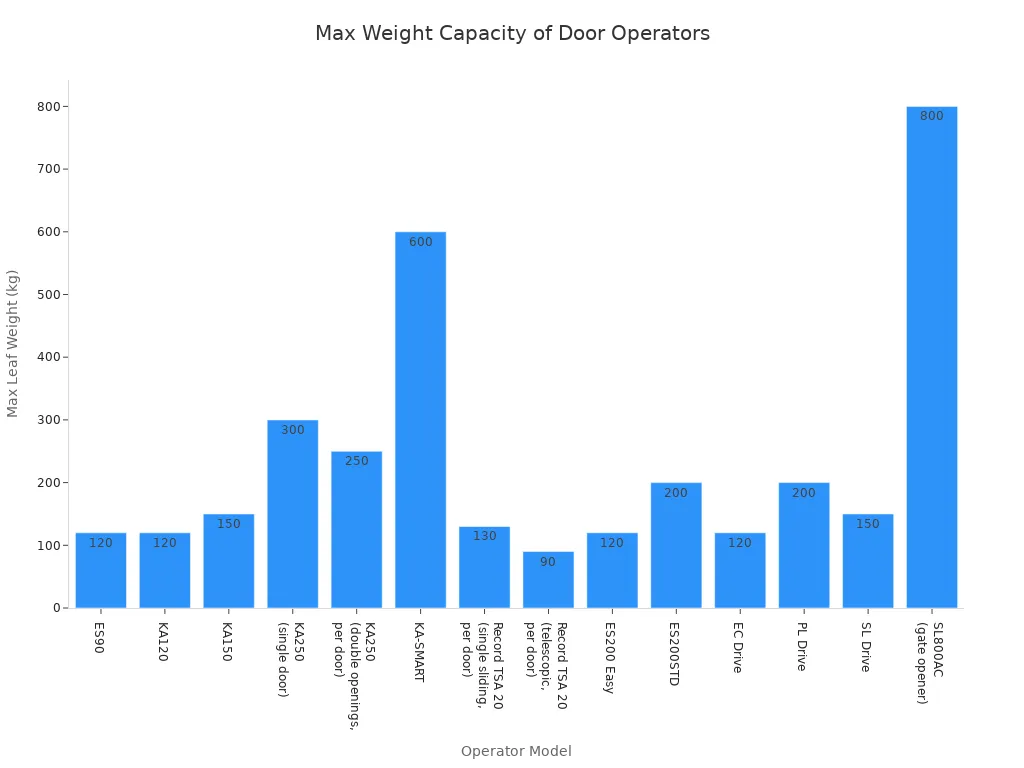
For a single opening setup, automatic sliding door operators typically manage two door panels. Each panel can weigh up to 150 kg. In a double opening configuration, the system handles four door panels. Each panel in this setup can weigh up to 120 kg. Heavy-duty operators can support even greater weights. For a single leaf configuration, the maximum door leaf weight can be 180 kg. In a double leaf configuration, each leaf can also weigh up to 180 kg. Some systems handle a single sliding door with two panels, each weighing up to 170 kg. Telescopic sliding doors on both sides can manage four panels, each weighing up to 130 kg.
Key Operator Features for Varied Traffic Volumes
Different traffic volumes demand specific operator features to ensure durability and efficiency. High-traffic environments require robust operators designed for continuous use.
Several operators offer heavy-duty performance suitable for demanding environments:
- PL Drive: This operator features a strong drive unit. It handles leaf weights up to 200 kg per leaf, making it ideal for high-traffic areas.
- SL Drive: Built for high-performance applications, the SL Drive ensures enhanced durability and precision. It offers high-speed operation and compatibility with various door configurations.
- ED100 / ED250: These powerful and versatile swing door operators suit high-traffic environments. They provide heavy-duty performance for continuous use and include integrated battery backup for uninterrupted operation. The ED100 handles door weights up to 100 kg, while the ED250 manages up to 250 kg.
The ASSA ABLOY SL500 sliding door operator is a reliable choice for high-traffic retail, transportation, and healthcare environments. Doors in these locations are constantly in use. It provides powerful yet smooth operation, effortlessly handling door weights up to 2x200kg or 1x240kg. It also offers flexible configuration options to meet facility needs. The Record STA20 automatic sliding door system is engineered for efficiency and built for high traffic. It provides a reliable and visually appealing entrance solution for various high-traffic environments. These include offices, retail stores, supermarkets, hospitals, schools, and public buildings. It supports both single and double-leaf configurations.
Essential Automatic Door Accessories for Enhanced Functionality
An automatic door system’s effectiveness extends beyond its operator. A range of Automatic Door Accessories plays a vital role in its overall functionality, safety, and security. These components ensure the system operates efficiently and meets the specific needs of its environment.
Activation Devices Tailored to Traffic Needs
Activation devices are the primary means by which users interact with an automatic door, signaling it to open. The selection of these Automatic Door Accessories depends heavily on the expected traffic volume and the desired user experience. Automatic activation devices include floor loop sensors, motion detectors, and presence detectors. These devices detect an approaching person or object and trigger the door to open without physical contact.
For environments requiring hands-free operation, various sensor-based activation devices are available:
- Dual Infrared and Microwave Sensors: The SSR-3 model combines K-Band 24.15Ghz microwave technology with active infrared detection.
- IR / Motion / Presence Sensors: The DH100-CT uses active infrared for both motion and presence sensing.
- High Mount IR Sensors: The DH400 employs active infrared technology, utilizing a floor reflection method for detection.
- Door Mount Presence Sensors: The SSS-5 integrates active infrared and Position Sensitive Detection (PSD) technology.
- Industrial/Pedestrian Microwave Sensors: The HR-Robus is a high-mount microwave motion sensor. It effectively detects both vehicle and pedestrian movement. This makes it suitable for commercial and pedestrian motion-activated doors, with a mounting height capability of up to 23 feet.
- Radar Movement Detectors: These sensors emit radar waves and detect reflections to sense movement.
Manual activation options also exist for specific applications. These include various push button variants, such as the TS-4 Single Gang Mount Button and SDC Push Plate Switches in different sizes and shapes. Switch variants, like program switches and key switches, offer controlled access. Remote controls and touchless exit switches provide convenient alternatives. For high-traffic retail environments, industry-grade door motion sensors are essential. They prioritize performance and durability to ensure seamless door operation.
Safety Sensors: Non-Negotiable for All Traffic Levels
Safety sensors are critical components of any automatic door system. They prevent accidents and ensure user protection. These Automatic Door Accessories are non-negotiable, regardless of traffic levels. Automatic sliding doors must adhere to strict safety standards. These include ANSI/BHMA A156.10 for Power Operated Pedestrian Doors, ANSI/BHMA A156.19 for Power Assist and Low Energy Power Operated Doors, and ANSI/BHMA A156.38 for Low Energy Power Operated Sliding and Folding Doors.
Door sensors must detect individuals from a sufficient distance. This allows for safe and convenient passage. Automatic doors should always include safety sensors. These sensors prevent the doors from closing on people or objects. Advanced sensors improve detection accuracy, which reduces the risk of impact or entrapment.
However, automatic sliding door sensors can exhibit blind zones, particularly in the door threshold area. Standard safety checks, such as those from AAADM, do not always identify these issues. Problems observed include erratic behavior of combination motion and presence sensors. Blind spots for detecting individuals of certain stature or clothing color also occur. Sensors can reach their end of useful life without notification. Improper wiring of photoelectric beams and failure to install required safety decals, in accordance with ANSI standards, have also been identified. Sensor adjustment issues, such as incorrect detection time settings, can lead to doors closing on individuals even after passing safety checks. Alternative sensor technologies, such as ceiling-mounted or through-the-threshold presence sensors, and audible/visual warnings, are available to prevent such accidents.
Common types of safety sensors include:
| Sensor Type | Detection Method | Pros | Cons |
|---|---|---|---|
| Infrared Sensors | Detects changes in heat (e.g., from a person’s body) | Reliable for detecting people; relatively inexpensive; works well | Prone to false positives; may not detect non-heat-generating objects |
| Pressure Sensors | Activated by force applied to a mat or surface | Simple and effective; ideal for specific traffic flow | Less sensitive to non-human objects; requires maintenance |
| Radar-Based Sensors | Emits radar waves and detects reflections | Fast activation; detects wide range of objects, including trolleys | More expensive; may detect irrelevant movements beyond intended zone |
Other sensor types include motion detector sensors, which primarily use microwave technology. Presence sensors activate via a wave sensor, ensuring safe operation if someone remains motionless within range. Dual technology sensors combine both motion and presence capabilities. Photoelectric beam sensors detect anyone within the threshold to prevent closing. Active infrared sensors emit a signal to the floor, activating when obstructed. Passive infrared sensors detect thermal patterns. Microwave sensors emit wide wavelengths and analyze bounce-back signals for proximity.
Control Systems and Security Features for Automatic Doors
Advanced control systems integrate with automatic sliding doors to enhance functionality and security. These systems allow for integration with access control mechanisms. Keycards or biometric scanners can restrict access to certain areas. This ensures only authorized individuals can enter. Property owners can manage user permissions and protect sensitive zones.
Benefits of integrating advanced control systems include:
- Access Control Systems: These systems allow selective entry using RFID cards, biometric systems, or PIN codes.
- Video Intercom Systems: They enable real-time communication and monitoring.
- Smart Integration: IoT-enabled doors can sync with building automation systems for seamless control.
- Connectivity: Advanced doors can connect to building management systems for remote monitoring and diagnostics.
- Enhanced Security Features: Biometric verification and integration with advanced surveillance systems provide robust protection.
- User Experience: Improved user interfaces and customization based on user behavior analytics enhance convenience.
These systems offer better accuracy. Radar, laser, and vision-based sensors provide superior accuracy and reliability. They precisely detect movement and differentiate between humans, objects, and animals. This reduces false triggers and ensures seamless operation. Improved energy conservation is another benefit. Advanced sensors and algorithms minimize the time doors remain open. This reduces heat loss or gain and optimizes energy usage by analyzing traffic patterns.
Security features incorporated into automatic sliding door systems include:
- Integrated Access Control: Automatic sliding glass doors integrate with biometric scanners, keycards, and PIN pads. This ensures only authorized personnel enter specific areas.
- Safety Sensors: These prevent doors from closing if people or objects are in the detection zone.
- Obstruction Reversal: If door leaves are obstructed during closing, they immediately reopen. If hindered during opening, an automatic reversing mechanism stops them.
- Mechanical Interlocks: These secure sliding doors and sidelites when fully closed.
- Safety Glass: Automatic doors typically use safety glass. It breaks into small, dull pieces upon impact, reducing injury risk.
- Manual Override: In case of power failure or malfunction, automatic doors include a manual override system. This allows manual opening or closing for emergency exits and injury prevention.
- Broader Security Integration: Low-energy automatic sliding doors integrate with larger access control systems for enhanced security. Interior automatic sliding doors can incorporate function keypads, keycard systems, and other access credential methods for heightened security. These door systems integrate into broader security systems to monitor credential usage and access times, improving oversight of sensitive areas.
Track and Roller Systems for Supporting Door Weight
The track and roller system forms the backbone of any automatic sliding door, directly supporting the door’s weight and guiding its movement. This system ensures smooth, quiet, and reliable operation. The choice of materials for both the rollers and the track significantly impacts the door’s longevity and overall performance. These components are essential Automatic Door Accessories, crucial for the door’s structural integrity and operational efficiency.
Different roller materials offer distinct advantages for various applications. Nylon rollers provide a lightweight and cost-effective solution. They deliver smooth operation with moderate noise reduction. Their durability contributes to the system’s longevity. Polyurethane rollers excel in vibration absorption and offer long-lasting performance. They are ideal for heavier sliding doors or industrial applications. Their superior vibration absorption directly enhances smooth operation and extends the system’s lifespan. Rubber-coated rollers offer superior noise-dampening. This feature is especially critical for residential settings where quiet operation is essential. The cushioning effect of these rollers contributes to smoother movement and reduces wear, extending the door’s lifespan. Metal rollers with coatings, such as steel or aluminum with rubber or polymer coatings, combine durability with noise reduction. They suit heavy-duty applications. The coatings help reduce friction and absorb vibrations, leading to smoother operation and increased longevity.
Bearing types within the rollers also play a vital role. Ball bearing rollers provide the smoothest operation. They are ideal for heavy doors. The rolling elements significantly reduce friction and mechanical wear, directly enhancing both longevity and smooth movement. Plain or sleeve bearing rollers are simpler and more cost-effective. However, they may produce more noise under heavy loads compared to ball bearings. This potentially impacts smoothness and long-term wear. Sealed bearings protect against dust, debris, and corrosion. They ensure quieter and longer-lasting performance by maintaining the integrity of the bearing mechanism. This is crucial for both smooth operation and an extended lifespan.
The choice of roller materials and bearing types directly impacts the longevity and smooth operation of automatic sliding doors. These specialized Automatic Door Accessories reduce friction and mechanical stress. Less friction leads to less heat and wear. This prolongs the lifespan of the roller, the track, and associated hardware. This reduction in mechanical stress contributes to smoother, easier operation. By combining vibration absorption, precise bearings, proper load distribution, and friction reduction, these rollers extend the service life of sliding doors. They also reduce maintenance requirements, prevent premature failure, and provide a consistently smooth and quiet user experience. Therefore, careful consideration of these Automatic Door Accessories is paramount for any automatic door system.
Installation and Maintenance for Optimal Automatic Door Performance
The Importance of Professional Installation
Professional installation is paramount for any automatic door system. Faulty installation is a primary cause of injuries. Doors may function unpredictably or fail to meet safety standards if not installed to manufacturer specifications. Incorrect alignment, poorly calibrated sensors, and inadequate structural support can lead to accidents. Certified technicians possess the necessary expertise to prevent these issues. For example, the American Association of Automatic Door Manufacturers (AAADM) certifies technicians. These professionals receive training on all components of automatic doors. They inspect existing doors for safety and reliability. An AAADM Certified Inspector candidate must have worked in the automatic pedestrian industry for six months immediately preceding the application. This ensures they have practical experience.
Regular Maintenance for Longevity and Safety
Regular maintenance significantly extends an automatic door’s lifespan and ensures its safe operation. Automatic doors should undergo a full inspection by a qualified engineer either annually or every six months. For most commercial buildings, automatic door maintenance should be scheduled at least twice a year. High-traffic environments may require quarterly or even monthly maintenance. During these checks, technicians activate the door to ensure it opens and closes at a slow, smooth pace. They inspect the floor area to ensure it is clear. They also check the door’s overall condition for loose parts and proper signage. Critical components to inspect include sensors, emergency stop functions, and door alignment. Technicians also examine moving parts like hinges, rollers, and tracks. Regular maintenance prevents costly repairs. Low-energy door operators typically last 10 to 15 years with proper installation and maintenance. Maintenance contracts, typically ranging from $100 to $300 annually, minimize downtime and prevent unexpected repair bills.
Careful evaluation of door weight and traffic flow is critical for selecting the correct automatic sliding door system. This ensures optimal performance. The right choices guarantee a safe, efficient, and durable automatic door. It perfectly tailors to specific needs.
Proper selection leads to enhanced safety, operational efficiency, and long-term durability for any automatic door installation.
FAQ
How does door weight influence the choice of an automatic door operator?
Door weight directly impacts the required operator power. Heavier doors demand more robust motors and stronger components. An underpowered operator experiences strain, leading to premature wear and potential malfunctions. Matching the operator’s capacity to the door’s weight ensures smooth, consistent operation and extends the system’s lifespan.
What operator features are essential for high-traffic environments?
High-traffic environments require operators built for continuous use and durability. Features like strong drive units, high-speed operation, and robust construction are crucial. Operators such as the PL Drive or SL Drive handle frequent opening and closing cycles efficiently, ensuring reliability in busy locations.
Are safety sensors always necessary for automatic doors?
Yes, safety sensors are non-negotiable for all automatic doors, regardless of traffic levels. They prevent accidents by detecting people or objects in the door’s path. Adherence to strict safety standards, like ANSI/BHMA A156.10, mandates their inclusion for user protection.
How often should automatic doors undergo maintenance?
Automatic doors require regular maintenance to ensure longevity and safe operation. Most commercial doors need inspection at least twice a year. High-traffic environments may necessitate quarterly or even monthly checks. Professional technicians perform these inspections, preventing costly repairs and ensuring optimal performance.