
Automatic door motors are the electromechanical devices that power the opening and closing of automatic doors. They convert electrical energy into mechanical motion, controlled by sensors and a central processing unit, enabling hands-free access in modern building entrances. Understanding How Automatic Door Motors Drive Sliding and Swing Doors Automatically reveals their sophisticated engineering. An OEM Automatic Door Motor Supplier for Global Markets provides these crucial components. Many consider Why Choose a Chinese Automatic Door Motor Manufacturer for quality and innovation. Various Automatic Door Accessories enhance system functionality.
Key Takeaways
- Automatic door motors power doors. They change electricity into movement. Sensors and a control unit tell them what to do.
- Automatic doors use sensors to see people. A control unit tells the motor to open or close the door. This makes doors work smoothly and safely.
- There are different motors for sliding, swing, and revolving doors. Each motor fits a certain door type and its use.
- Automatic doors help everyone get in easily. They save energy by keeping warm or cool air inside. They also have safety features to prevent accidents.
- Regular checks keep automatic doors working well. This helps them last longer and stay safe for everyone.
Core Components of an Automatic Door System
The Automatic Door Motor
The automatic door motor stands as the central power unit within any automatic door system. It converts electrical energy into the mechanical force necessary to open and close doors smoothly. This electromechanical device receives commands from the control unit, dictating the precise timing and speed of door operation. Manufacturers design these motors for continuous, reliable performance, ensuring consistent access in high-traffic environments. The motor’s efficiency directly impacts the door’s responsiveness and overall energy consumption.
Sensors for Detection
Sensors act as the "eyes" of an automatic door system, detecting the presence of individuals or objects. They initiate the door’s opening sequence, ensuring safe and convenient passage. Different types of sensors serve specific functions:
- Motion Detector Sensors primarily use microwave technology. They detect movement from people, objects, or animals, triggering the door’s opening.
- Presence Sensors activate through wave sensors. These ensure the door operates safely at a reduced speed if someone remains motionless within its range, preventing collisions.
- Dual Technology Sensors combine both motion and presence sensing capabilities. Some models project a light row to indicate presence.
- Photoelectric Beam Sensors sit on either side of the door. They work with other sensors to detect anyone in the threshold, preventing the door from closing on them.
- Active Infrared Sensors emit an infrared signal to the floor. The door activates when the signal bounces back due to an obstruction.
- Passive Infrared Sensors detect thermal patterns (heat sources) in the vicinity to activate the door.
- Microwave Sensors emit and analyze returning wavelengths to determine an object’s proximity.
Automatic door systems utilize various sensors, including microwave sensors, also known as microwave radar. These sensors respond to moving objects and suit areas with normal walking speeds. However, they cannot detect stationary individuals, potentially leading to the door closing on them. Infrared sensors detect objects by recognizing their temperature, regardless of movement, within their scanning range. Their disadvantages include a slower reaction time compared to microwave sensors. They also may not respond to humans when body temperature is similar to the environment or when individuals wear heavy clothing.
Control Unit and Processing
The control unit serves as the "brain" of the automatic door system. It processes all incoming information and issues commands to the motor. This sophisticated component ensures the door operates safely and efficiently.
- The automatic door controller receives activation and feedback from sensors. It detects when a pedestrian is present.
- It sends power to the DC motor to operate the door. The control unit determines when to open or close the door.
- Based on sensor input, it instructs the motor to open the door. It keeps the door open while a person passes through. Then, it closes the door once the person is out of range.
Control units often employ various communication protocols to integrate with larger building management systems. Common protocols include:
- BACnet
- LON
- Modbus
Automatic doors and curtain openers utilize CAN networks. CAN also finds employment in subsystems like door control within trains. Furthermore, CANopen is used in nonindustrial applications such as automatic doors. These protocols allow for seamless communication and centralized management of door operations within a modern building infrastructure.
Transmission System
The transmission system acts as the crucial link between the automatic door motor and the door panels themselves. It translates the rotational energy produced by the motor into the linear or swinging motion required to open and close the door. This system ensures smooth, controlled, and precise movement, directly impacting the door’s operational efficiency and longevity. Without an effective transmission, the motor’s power would not reach the door in a usable form.
Automatic door systems employ different types of transmission mechanisms to achieve door movement. These mechanisms are engineered to suit various door types and operational demands.
-
Electro-Mechanical Doors: These systems utilize an electric motor combined with mechanical components to facilitate door movement. They are commonly found in various settings such as commercial buildings, retail establishments, and healthcare facilities. A belt, chain, or gear system typically connects the motor to the door. The motor drives these mechanical components, which then pull or push the door panels along their tracks or pivot them on their hinges. This design offers reliability and cost-effectiveness for many standard applications.
-
Electro-Hydraulic Doors: These systems integrate electrical and hydraulic mechanisms for operation. An electric motor powers a hydraulic system that controls the door’s opening and closing. They are typically employed in demanding environments or areas with high foot traffic, where a more robust solution is necessary. The hydraulic fluid provides a smooth and powerful force, allowing these doors to handle heavier loads and operate with greater precision, often seen in industrial settings or large public entrances.
The choice of transmission system depends on factors like door weight, required speed, frequency of use, and environmental conditions. Each system offers specific advantages, ensuring the automatic door operates effectively and safely for its intended purpose.
How Automatic Door Motors Operate
Detection and Signal
The operation of an automatic door system begins with detection. Sensors, strategically placed around the door, constantly monitor the surrounding environment for activity. When a person approaches the entrance, these sensors immediately register their presence. For instance, microwave sensors emit signals and detect changes in the reflected waves, indicating movement. Infrared sensors, on the other hand, detect thermal patterns or disruptions in an infrared beam. This detection process occurs with remarkable speed. The automatic door system typically detects people and initiates the opening sequence in milliseconds, ensuring a smooth and efficient entry. Specifically, an automatic door infrared motion and presence safety sensor boasts a response time of less than or equal to 100 milliseconds. This rapid detection generates an electrical signal, which then transmits to the control unit, signaling the need for door activation.
Command Generation
Upon receiving the detection signal from the sensors, the control unit, acting as the system’s central processor, immediately begins its work. It analyzes the incoming data, interpreting the signal to determine the appropriate action. The control unit considers various factors, such as the type of sensor activated, the direction of approach, and any pre-programmed operational parameters. For example, it differentiates between a person approaching to enter and someone simply passing by. Based on this analysis, the control unit generates a precise command. This command instructs the automatic door motor on how to operate, specifying actions like opening speed, hold-open time, and closing sequence. It ensures the door responds correctly and safely to each unique situation.
Motor Activation and Movement
The automatic door motor receives the command from the control unit and immediately activates. This activation converts electrical energy into mechanical motion, initiating the door’s movement. For sliding doors, the motor drives a belt or chain system, which pulls the door panels along their tracks. For swing doors, the motor engages a mechanism that pivots the door on its hinges. The motor controls the speed and force of the door’s movement, ensuring a smooth and controlled operation.
Automatic door motor activation and movement adhere to strict safety and operational requirements. Organizations like the American Association of Automatic Door Manufacturers (AAADM) provide essential guidelines for user safety and accident prevention. Builders Hardware Manufacturers’ Association (BHMA A156 standards) also reference automatic door safety standards in building codes. These standards address various types of operators:
- Power-operated doors: These doors open for pedestrians when a motion sensor or pressure pad initiates the action.
- Low-energy, power-operated doors: These doors open via a button or panel control near the door.
- Power-assist doors: These doors feature a mechanism that reduces the opening force, closing when the force releases. They are less common and typically appear on very large doors.
International standards also govern these operations. The European standard EN 16005 sets minimum requirements for motion sensors and other safety devices. It defines door response times and detection ranges, requiring obstacle detection and auto-reverse features. It also mandates emergency opening and break-out mechanisms. Similarly, the United States standard ANSI/BHMA A156.10 covers activation sensor range and door opening speeds. It specifies force limitations for both opening and closing actions, detailing the proper placement of safety beams and presence sensors. This standard also includes requirements for signage and manual override options. These regulations ensure the door operates safely, preventing accidents and providing a reliable user experience.
Holding and Closing Sequence
After the automatic door motor activates and the door opens, the system enters its holding sequence. The control unit maintains the door in its open position for a predetermined duration. This "hold-open time" allows individuals to pass through comfortably. Building managers can often adjust this time to suit specific traffic patterns or accessibility needs. For instance, a busy hospital entrance might have a longer hold-open time than a less frequented office door. During this phase, the sensors continue to monitor the doorway. If a person remains within the detection zone, the control unit extends the hold-open time. This prevents the door from closing prematurely on someone.
Once the hold-open time expires and the sensors confirm the doorway is clear, the control unit initiates the closing sequence. It sends a command to the automatic door motor to reverse its action. The motor then smoothly pulls or pushes the door panels back to their closed position. Safety remains paramount during this phase. The system employs several mechanisms to prevent accidents:
- Reduced Closing Speed: Many automatic doors close at a slower speed than they open. This provides an extra margin of safety.
- Presence Sensor Activation: If a presence sensor detects an obstruction during closing, it immediately halts the door’s movement.
- Auto-Reverse Function: Should the door encounter an object or person while closing, the motor automatically reverses direction. It reopens the door to prevent impact or entrapment. This feature is crucial for user safety.
The motor’s precise control ensures a gentle and quiet closing action. It avoids abrupt movements that could startle users or cause wear and tear on the door mechanism. Modern systems often incorporate soft-close features. These features decelerate the door just before it reaches the frame. This minimizes noise and extends the lifespan of the door components. The entire holding and closing sequence demonstrates the sophisticated interplay between sensors, the control unit, and the automatic door motor. This integration ensures both convenience and safety for all users.
Tip: Regular maintenance checks ensure the sensors and auto-reverse functions operate correctly. This is vital for continuous safe operation.
International standards, such as ANSI/BHMA A156.10 in the United States and EN 16005 in Europe, heavily influence the design and operation of these sequences. These standards mandate specific requirements for closing forces, detection zones, and reaction times for safety features. They ensure automatic doors provide reliable and secure access in various environments.
Types of Automatic Door Motors and Applications
Automatic door motors come in various designs. Each design suits specific door types and their intended applications. These motors ensure efficient and safe operation across diverse environments.
Sliding Door Motors
Sliding door motors power doors that move horizontally along a track. They drive seamless operation of large doors in commercial buildings. These motors enhance commercial building security by restricting unauthorized access. They also provide large door automation for increased efficiency and productivity. This reduces labor costs by minimizing manual operation. Manufacturers offer customization for various door types and sizes, including small retail stores and large warehouses. For example, the Autoslide with an Elite Motor works well in light-commercial environments such as a doctor’s office.
Typical load capacities for automatic sliding door motors generally range from 150 to 440 lbs. Industrial heavy-duty automatic sliding door motors can handle maximum loads up to 1300 kg. Other industrial models offer maximum loading weights of 800 kg, 1200 kg, and 500 kg. Residential sliding door motors also have significant capacities, such as 500 kg (A2201 model) and 800 kg (A2203 model). Matching the motor’s rated load to the door’s actual weight is crucial. Exceeding these limits can lead to premature motor wear.
Swing Door Motors
Swing door motors operate doors that pivot on hinges, similar to traditional manual doors. The ASSA ABLOY SW60 swing door operator is suitable for public buildings. These motors find common use in:
- Airports
- Schools
- Hospitals
- Public buildings in general
Revolving Door Motors
Revolving door motors power doors that rotate around a central axis. They are ideal for high-traffic areas. These motors are frequently found in:
- Healthcare facilities
- Universities
- Airport terminals
- Office blocks
- Banks
- Health clubs
Revolving doors also provide one-way secure access from secure to non-secure areas in airports. They offer controlled two-way access in pharmaceutical labs. Revolving door systems also manage high pedestrian throughput.
| Door Type | Throughput Capacity (people per minute) |
|---|---|
| Standard 3-wing revolving door | Up to 20 |
| Larger 4-wing revolving door | Up to 30 |
| 4-wing revolving door (2-way access) | Up to 29 |
| Larger 4-wing frame revolving turnstile | Up to 40 |
Benefits and Automatic Door Accessories in Modern Entrances
Enhanced Accessibility and Convenience
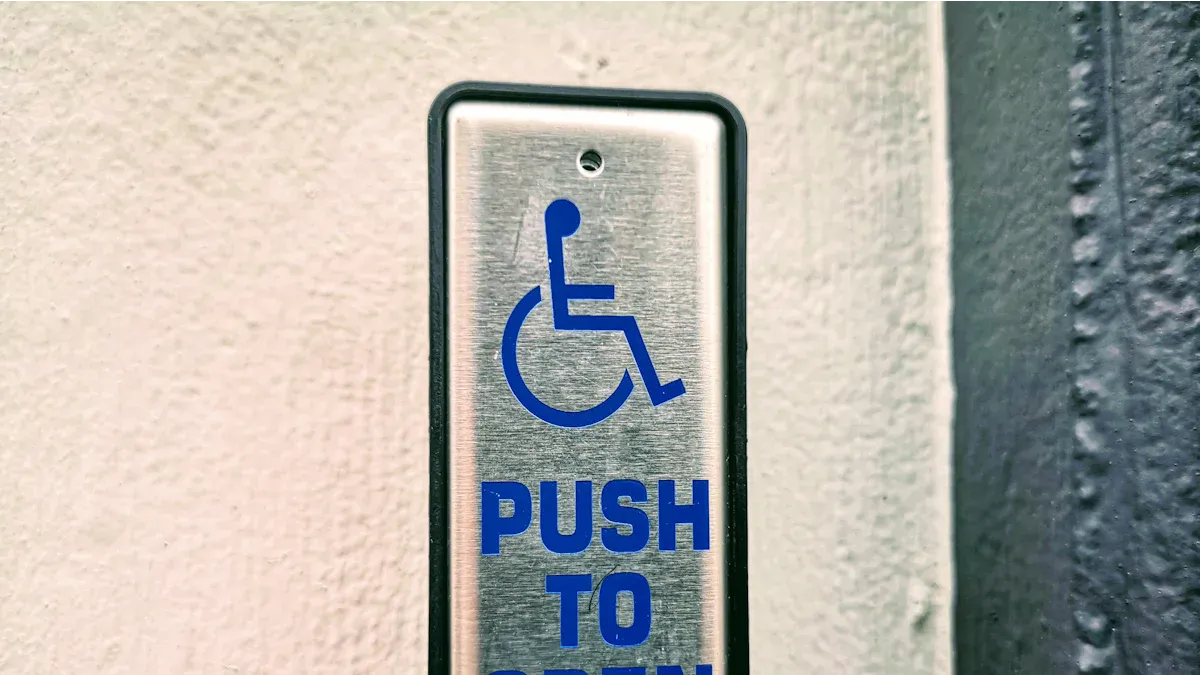
Automatic doors significantly improve accessibility and convenience for all users. They provide hands-free entry, which benefits individuals with disabilities, parents with strollers, and people carrying packages. The 2021 International Building Code (IBC) mandates that at least 60 percent of all public entrances must meet accessibility requirements. Furthermore, in specific facilities, these accessible public entrances must feature a full power-operated or low-energy power-operated door. This ensures easy access for everyone. Surveys consistently show high user satisfaction rates for automatic door systems, with automatic car door closers achieving over 90% satisfaction. These systems, often enhanced by various Automatic Door Accessories, make building entry effortless and inclusive.
Energy Efficiency and Climate Control
Automatic doors play a crucial role in maintaining building energy efficiency and climate control. They reduce energy consumption significantly. Automatic sliding doors can cut energy use by as much as 50% compared to traditional doors. This happens because they minimize air infiltration and help maintain stable indoor temperatures, which lowers heating and cooling costs. Automatic doors achieve consistent indoor temperatures by opening and closing precisely when needed. Advanced sensors detect movement and open only when necessary, reducing the time the door remains open. This significantly minimizes air leakage. Revolving doors, a type of automatic door, act as airlocks, further preventing the loss of heated or cooled air. Various Automatic Door Accessories, such as insulated glass and weatherstripping, also contribute to better thermal performance.
Safety and Security Features
Modern automatic door systems integrate numerous features that enhance both safety and security. Advanced sensors act as "invisible gatekeepers," constantly scanning for movement and presence. They prevent doors from closing if someone stands in the doorway, avoiding collisions. Anti-pinch protection detects obstructions between door panels, immediately stopping or reversing door movement to prevent injuries. Emergency battery backups allow doors to operate during power failures, maintaining access and safety. Soft-closing mechanisms ensure smooth and quiet operation, reducing wear and tear and providing sufficient reaction time for anyone in the door’s path. Manual override options allow non-electronic operation during system malfunctions. These safety features, often part of comprehensive Automatic Door Accessories packages, ensure user protection. For security, automatic door systems allow control over who enters or exits a premises, preventing unauthorized access. They integrate with access control systems, such as keycard readers or biometric scanners, to secure restricted areas. This enhanced protection, supported by robust Automatic Door Accessories, can even lead to lower insurance premiums.
Automatic door motors are indispensable for modern building entrances. They ensure seamless, safe, and efficient access for all users. Their sophisticated operation, driven by integrated sensors and intelligent control units, delivers significant benefits. This technology provides unparalleled convenience, enhances accessibility, and contributes to substantial energy savings. Consequently, automatic door motors have become a cornerstone of contemporary architectural design, defining modern building functionality.
FAQ
How long do automatic door motors typically last?
Automatic door motors generally offer a long lifespan. Manufacturers design them for continuous, reliable performance. Their durability depends on usage frequency, maintenance, and environmental conditions. Regular servicing helps extend their operational life significantly. 🛠️
What happens if an automatic door loses power?
Most automatic doors feature emergency battery backups. These systems allow continued operation during power failures. If a battery backup is not present, the door often defaults to a manual mode. Users can then push or pull the door open. 🔋
How do automatic doors ensure user safety?
Automatic doors prioritize user safety through advanced sensors. These sensors detect presence and movement, preventing the door from closing on individuals. Features like auto-reverse and anti-pinch protection also stop or reverse the door upon obstruction. 🛑
Can automatic doors save energy?
Yes, automatic doors contribute to energy efficiency. They minimize air infiltration by opening only when necessary and closing promptly. This precise operation helps maintain stable indoor temperatures. Consequently, buildings reduce heating and cooling costs. 💡